How to Check Your Dog’s Body Condition Score at Home
Medically reviewed by Dr. Alex German, BVSc PhD CertSAM DipECVIM-CA — Reader in Small Animal Medicine, University of Liverpool
Key Takeaways
- A body condition score is a two-minute, hands-on check of ribs, waist and belly.
- On the 9-point scale, 4-5 is ideal; each point above 5 is roughly 10-15% excess weight.
- You should feel the ribs easily, see a waist from above and an upward belly slope from the side.
- If two of the three checks fail, ask your veterinary practice for a full assessment.
The quickest way to find out whether your dog is a healthy weight is a body condition score (BCS): a simple hands-on check of the ribs, waist and belly that takes under two minutes and needs no equipment. Used by veterinary teams worldwide, it is more reliable than the scales alone, because a healthy weight varies enormously between breeds and individual dogs.
What is a body condition score?
A body condition score is a standardised way of grading how much fat cover a dog is carrying. Most veterinary practices, including our clinic, use a 9-point scale: 1 means severely underweight, 9 means severely obese, and 4–5 is the ideal range. Each step above 5 corresponds to roughly 10–15% excess body weight, so a dog scoring 7 is likely carrying about 20–30% more weight than is healthy.
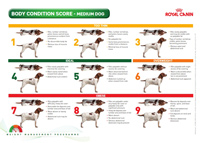
How do I check my dog’s body condition at home?
Work through three checks, in this order:
- Ribs. Run both palms flat along your dog’s ribcage. You should feel each rib easily under a thin layer of tissue — about the same feel as the back of your hand. If you have to press to find the ribs, there is excess fat cover.
- Waist. Look down at your dog from above. Behind the ribs there should be a visible narrowing before the hips. If the outline runs straight, or bulges outwards, the waist has been lost.
- Abdominal tuck. Look from the side. The belly should slope upwards from the ribcage towards the hind legs. A hanging or level belly line suggests abdominal fat.
If your dog fails two or three of these checks, book a visit to your veterinary practice for a proper assessment and an accurate weight.
Why is weight alone not enough?
Two healthy dogs of the same breed can differ in weight by several kilograms, and crossbreeds have no chart to sit on at all. Muscle also weighs more than fat, so a lean, well-muscled dog can weigh the same as an overweight, under-muscled one. Body condition scoring cuts through this by assessing the fat itself rather than the number on the scales. At the clinic we combine both: the score tells us whether there is excess fat, the scales let us track change precisely over time.
What should I do if my dog is overweight?
Start with your own veterinary practice. Many surgeries run free nurse-led weight clinics, and your vet can rule out medical causes of weight gain before any diet change. For dogs that struggle to lose weight in first-opinion practice — or that have other health problems alongside obesity — your vet can refer you to a specialist service such as the ROYAL CANIN® Weight Management Clinic. A structured programme typically combines an accurate target weight, a purpose-formulated weight-loss diet fed in weighed portions, and regular weigh-ins to keep progress on track. A safe rate of loss is around 1–2% of body weight per week.
Frequently Asked Questions
How often should I check my dog's body condition?
Once a month is enough for most adult dogs. Monthly checks catch gradual weight gain early, when it is easiest to correct with small feeding adjustments.
Does the 9-point body condition scale work for puppies?
Growing dogs are assessed differently because their body shape changes rapidly. Ask your veterinary team to show you what a healthy growth curve looks like for your puppy's breed and expected adult size.
My dog's breed is naturally stocky - do the same checks apply?
Yes. The ribs, waist and tuck checks assess fat cover directly, so they work across body types. Stocky breeds have a less pronounced waist, but the ribs should still be easy to feel.
References
- German AJ. The growing problem of obesity in dogs and cats. Journal of Nutrition. 2006;136(7):1940S-1946S.
- Kealy RD, Lawler DF, Ballam JM, et al. Effects of diet restriction on life span and age-related changes in dogs. Journal of the American Veterinary Medical Association. 2002;220(9):1315-1320.
- WSAVA Global Nutrition Committee. Body condition score chart (dog). https://wsava.org/global-guidelines/global-nutrition-guidelines/
- German AJ, Holden SL, Moxham GL, et al. A simple, reliable tool for owners to assess the body condition of their dog or cat. Journal of Nutrition. 2006;136(7):2031S-2033S.

Georgia Woods
RVN — ROYAL CANIN® Weight Management Clinic Nurse
Georgia Woods trained as a Veterinary Nurse in 2001 and qualified in 2004, going on to run nurse-led obesity clinics and work in emergency and critical care. She completed the ROYAL CANIN® Pet Health Councillor course, and since 2015 has been the ROYAL CANIN® Weight Management Clinic Nurse at the University of Liverpool Small Animal Teaching Hospital, where she works exclusively with obese pets.
This article is for general information only and is not a substitute for professional veterinary advice. Always consult your veterinary surgeon about the health of your pet.