Service Dog Training Cost: What You’ll Really Pay in 2026
Key Takeaways
- Service dog training costs range from $10,000 to $50,000 depending on task complexity, dog breed, and program type. Training a PTSD service dog, for example, costs approximately $35,000.
- The overall cost is shaped by several factors: type of service dog, number of specific tasks trained, length of the training process, and whether you purchase a finished dog or do owner training with your own dog.
- Under U.S. law (ADA), service dogs are defined by what they are trained to do-not by any license, vest, or registration. There is no federal requirement to "certify" a service dog.
- Grants, nonprofit organizations, VA benefits for qualifying veterans, tax deductible medical-expense deductions, and community fundraising can substantially reduce out-of-pocket costs.
- Before committing, compare at least three training programs, understand annual maintenance costs of $3,590 to $4,330, and honestly assess whether a service dog fits your disability, daily life, and lifestyle. Speak with your medical team and at least one current handler before making a decision.
A fully trained service dog from a professional program typically costs between $15,000 and $50,000 in 2026, though some handlers reduce that figure to $3,000–$10,000 by training their own dog over one to two years. The final number depends on the type of tasks required, the training organization you choose, and where you live. This guide breaks down every cost category so you can plan with confidence.
What is the typical cost to get a trained service dog?
Most people pay between $15,000 and over $50,000 for a professionally trained service dog in 2026. The range depends on the training organization, the tasks required, and regional cost differences. Service dog training costs range from $10,000 to $50,000, with specialized medical alert dogs or psychiatric service dogs pushing toward the upper end.
Here is how costs break down by program type:
-
Nonprofit placement (low or no fee to recipient): Some organizations provide service dogs at no cost to recipients. The nonprofit’s internal cost per dog still exceeds $20,000–$30,000, subsidized by donations. Wait times run one to three years.
-
Partial-fee / hybrid models: Programs charge the handler $5,000–$10,000 while fundraising or grants cover the remainder. Initial costs for owning a service dog through these models can total $7,125 to $13,350 once equipment, travel, and handler training are factored in.
-
Full-fare private trainers: Expect $25,000–$40,000+. These programs often have shorter waitlists and offer highly trained dogs with intensive task work and follow-up support.
Training your own service dog is the lowest-cash-outlay path, typically $3,000–$10,000 over 12–24 months, but it demands hundreds of hours of personal effort and consistent daily practice.
Training costs can vary based on location and trainer reputation. Coastal metro areas and urban areas tend to sit at the high end, while programs in lower cost-of-living regions-parts of the rural Midwest or states like New Mexico-trend lower. Inflation since 2020 has pushed many programs toward the upper end of older published ranges.
What types of service dogs affect training cost?
Different categories of service dogs demand different lengths and intensities of training, which directly impacts cost. Under the ADA, a service animal must be individually trained to perform specific tasks for a person with a disability-a distinction that separates service dogs from therapy dogs and emotional support animals.
Here are common types and their relative cost levels:
-
Guide dogs for blindness or low vision-complex navigation and obstacle avoidance training; high cost.
-
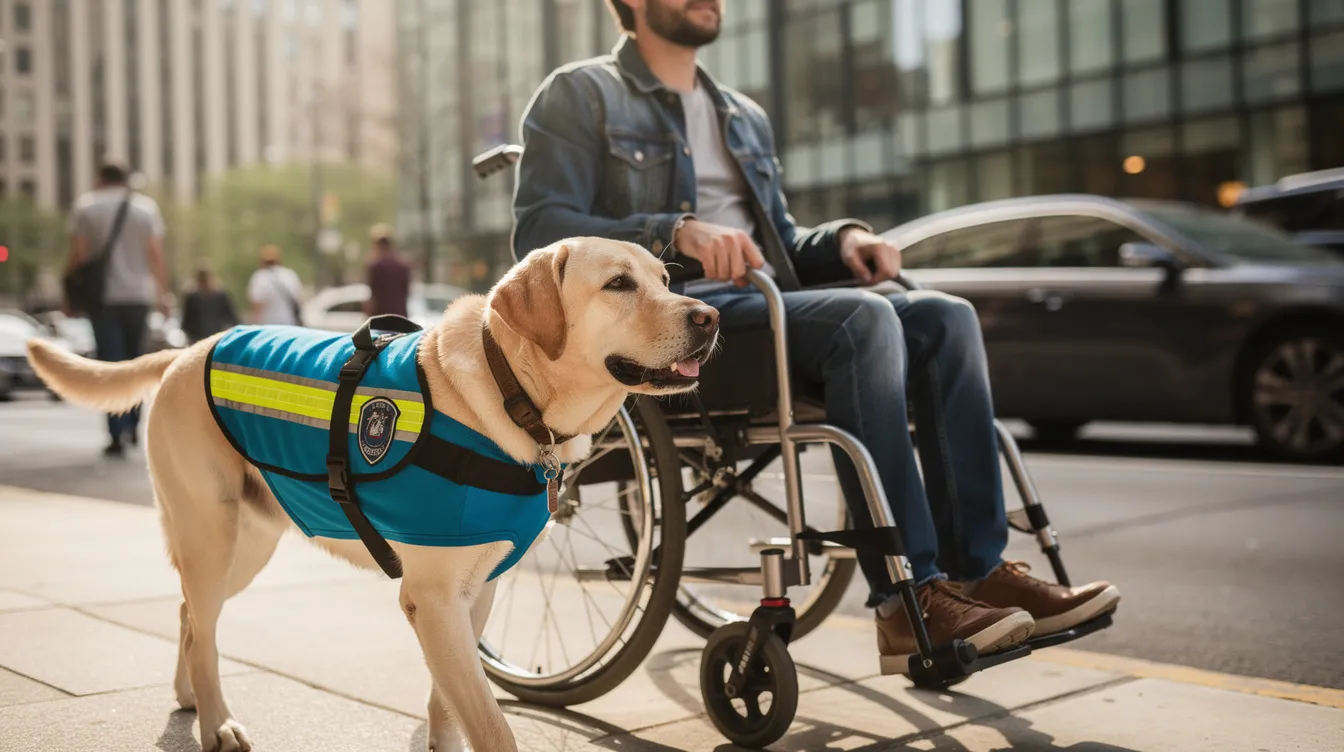
Mobility assistance dogs-retrieving dropped items, opening doors, balance support. Basic mobility assistance training costs between $15,000 and $30,000.
-
Hearing dogs-alerting to sounds like alarms or doorbells; moderate cost.
-
Psychiatric service dogs (PTSD, anxiety)-interrupting panic attacks, reminding medication, deep pressure therapy. PTSD service dogs cost approximately $35,000 to train.
-
Medical alert dogs-detecting changes in blood sugar, oncoming seizures, or other medical events through scent work. These often push toward $40,000–$50,000 because specialized, high-level tasks require more intense training and proofing across many environments.
-
Autism support service dogs for children-tethering, calming, sensory support; high cost due to family-oriented socialization.
Specific tasks increase the complexity and cost of training. Dogs performing life-preserving tasks need advanced scent training and reliable performance in crowded stores, airports, and other public places, adding hundreds of trainer hours.
Emotional support animals, by contrast, are not covered under the ADA as service animals. They typically receive only basic obedience and manners training, so their costs are far lower. Some organizations specialize in one type-separate programs exist for guide dogs versus PTSD assistance dogs-which can improve quality but also influence pricing and wait times.
How does the service dog training process work?
Most professionally bred and trained service dogs spend 18–24 months in structured programs from puppyhood to public-ready status, following standards set by organizations like Assistance Dogs International. Training a service dog requires months of specialized work across several phases.
Main phases of training:
-
Puppy raising and early socialization (8 weeks to ~12–16 months): Volunteer puppy raisers or staff expose the puppy to varied environments, sounds, surfaces, and people. Socialization at this stage is critical-it builds the foundation for everything that follows.
-
Basic obedience (4–12 months): The dog learns basic commands-sit, down, stay, recall, leash walking, and crate training. Basic obedience training for service dogs is essential and forms the platform for all specialized work. Many handlers also attend puppy classes during this phase.
-
Public access training (12–18 months): Controlled exposure to real-world settings-stores, buses, medical offices, elevators, crowds. The dog must demonstrate good behavior in distracting environments.
-
Specialized task training (concurrent and intensifying after obedience): Retrieving items, deep pressure therapy, alerting to medical changes, or guiding through obstacles-depending on the handler’s disability.
-
Handler training: The person with a disability learns to work effectively with the dog, practicing cues, handling, and public access as a team, ensuring seamless communication between handler and dog.
For owner-training, these steps follow the same sequence but usually take longer-often 18–30 months-because handlers are learning as they go. Training usually spans 1–2 years regardless of path.
Training is ongoing even after placement. Most teams need regular refresher sessions, and some handlers add new tasks as their needs change. Many reputable programs perform periodic team check-ins, though no federal law requires recertification.

What influences the cost of service dog training the most?
Several factors explain why quotes for service dog training can differ by tens of thousands of dollars. Understanding these cost drivers helps you evaluate what you are actually paying for.
Key factors that influence pricing:
-
Training model: A dog bred, raised, and fully trained by a program costs far more than a handler’s own dog trained with professional support.
-
Task complexity and number of tasks: A dog that must assist people with multiple daily tasks-mobility assistance, medical alerts, psychiatric intervention-requires more training hours than one learning a single function.
-
Dog’s age and starting point: An untrained puppy needs 18+ months of development. Initial costs for adopting a service dog as a puppy from a responsible breeder range from $2,000 to $3,000, but the subsequent training investment is substantial.
-
Breed and health screening: Breeds like labrador retrievers and golden retrievers are popular because of their right temperament for service work, but responsible breeding program costs (hip, elbow, eye, and genetic screens) add up.
-
Geographic region: Trainer wages, veterinary care, and facility costs differ sharply between urban areas and rural regions.
-
Trainer reputation and certifications: Higher staff-to-dog ratios and experienced professional trainers command premium rates.
Some dogs wash out during training due to health or temperament issues. Programs absorb these sunk costs and distribute them across successful placements, which is one reason fees seem high. Intensive task training-especially medical alert work-requires countless repetitions, adding hundreds of trainer hours to the bill.
Questions to ask any training center: What health tests are included? Is follow-up training covered? What happens if the dog washes out? What equipment is provided?
How much does it cost to train your own service dog?
Owner-training is legally permitted under the ADA, and it can reduce cash costs to roughly $3,000–$10,000 over 1–2 years. However, it demands hundreds of hours of personal work, consistent daily practice, and access to skilled detailed guidance from experienced trainers.
Common expense categories for self training:
-
Dog acquisition: A well-bred puppy with health clearances from a responsible breeder typically costs $1,500–$4,000. Initial costs for adopting a service dog from a rescue or rehoming situation range from $2,000 to $3,000.
-
Group obedience classes: Puppy classes ($100–$300) and basic obedience ($300–$600).
-
Advanced or task-specific classes: Specialized work like scent training or mobility assistance tasks often requires private coaching sessions.
-
Private coaching: Professional trainer fees can range from $100 to $300 per hour. Budget for at least one full series of in-person group classes plus periodic one-on-one sessions with a trainer experienced in service dog work.
-
Online or virtual programs: Lower cost but variable quality; should not replace hands-on guidance.
-
Training gear: Harnesses, leashes, vests, treat pouches, grooming tools, enrichment toys, and crates can total several hundred to a few thousand dollars.
Cost depends heavily on whether you start with an 8-week-old puppy or an older adolescent with some training. Not every dog will have the temperament or health to become a reliable service dog. Before committing, have your own dog professionally evaluated by trainers who train dogs for service work. A failed attempt costs money, time, and emotional energy.
Some states allow service dogs in training to practice public access when accompanied by a handler or trainer, but rules vary-check your own state statutes.
What are the ongoing costs of owning a service dog?
Training is only part of the financial commitment. Day-to-day care and long-term health expenses continue for the dog’s 8–12+ year working life, and annual maintenance costs for a service dog range from $3,590 to $4,330.
Recurring annual cost categories:
|
Category |
Estimated Annual Cost |
|---|---|
|
Food and treats |
$800–$1,500 |
|
Routine veterinary care (exams, vaccinations, preventives) |
$500–$1,200 |
|
Emergency / specialist vet visits |
Variable (budget $500–$2,000+) |
|
Grooming and nail care |
$200–$600 |
|
Equipment replacement (harnesses, vests, leashes) |
$200–$1,000 |
|
Ongoing training refreshers |
$500–$2,000 |
Ongoing care expenses for service dogs can exceed $500 annually in veterinary care alone. Additional costs include pet insurance ($300–$800/year), boarding or pet-sitting during handler hospitalizations, and dog daycare or walking services when handlers cannot exercise the dog themselves.
Post-training expenses for service dogs can total $2,000 to $4,000 annually. Many families find that budgeting $3,000–$4,000 per year covers routine care, while setting aside a separate emergency fund prevents financial burden when unexpected health issues arise. Food quality matters-working dogs need adequate nutrition to perform daily tasks reliably.

What funding options can help pay for service dog training?
Although the financial commitment is significant, a mix of nonprofit support and creative funding options can make service dog training more attainable. Most private health insurance plans do not cover service dog training costs, but several other avenues exist.
Key funding avenues:
-
Nonprofit organizations: Many ADI-accredited programs place service dogs at low or no cost. Canine Companions provides service dogs free of charge. Some nonprofits provide trained service dogs at little or no cost; applicants typically need documented disability and demonstrated ability to care for the dog.
-
Grants and charitable foundations: Organizations like the dog alliance and similar foundations offer financial assistance specifically for service dog teams. A medical professional’s letter may be required for funding applications.
-
Veterans programs: Donations support the training of service dogs for veterans. The VA may cover veterinary health insurance, equipment, and travel for training through qualifying ADI-accredited programs.
-
FSA / HSA accounts: If a medical provider prescribes a service dog, some related costs may be reimbursable through employer flexible spending or health savings accounts. Service-dog-related expenses can also be tax deductible as medical expenses when itemizing.
-
Community fundraising: Verified crowdfunding platforms, religious communities, and local communities such as civic clubs can help cover costs.
Carefully vet any organization that offers “instant” service dog registrations or ID cards for a fee-these do not replace real training and carry no legal weight under the ADA. Look for ADI-accredited programs by searching the Assistance Dogs International member directory for options in your region.
How to choose a reputable service dog training organization
The choice of training organization may matter more than the exact price quote. Your safety, greater independence, and ability to live more independent lives will depend on the dog’s reliability in real-world situations.
Evaluation criteria:
-
Accreditation or membership in Assistance Dogs International or similar recognized body.
-
Transparent description of training methods-evidence-based, humane, and largely built on positive reinforcement rather than harsh corrections.
-
Written contracts spelling out what tasks will be trained, what follow-up support is included, and what happens if the dog washes out.
-
Health screening protocols for breeding program dogs and client-owned dogs entering the program.
-
Staff qualifications: years of experience, certifications, and continuing education.
Questions to ask:
-
What is your program’s success rate and typical wait time?
-
Do you accept client-owned dogs or only program-bred dogs?
-
How do you handle behavior issues after placement?
-
What equipment is included in the fee?
Red flags: Promises of “fully trained service dogs” in a few weeks, guarantees that any breed can become a service dog, or heavy reliance on aversive equipment. Legitimate programs that train dogs for service work-including explosives detection dogs or guide dogs-invest months, not days.
Under ADA rules, businesses in other public places may only ask two questions about a service dog and cannot demand certification documents. This is an important element of service dog rights every handler should understand.
Do you need certification or a license for a service dog?
Under U.S. federal law (ADA), there is no national certification, registration, or licensing requirement for service dogs. A dog’s legal status comes entirely from its training to perform specific tasks for a person with a disability.
Important distinctions:
-
Legitimate training documentation: Issued by a program for the handler’s personal records-useful but not legally required to carry.
-
Voluntary public access tests: Some organizations use these to evaluate a team’s readiness. They are good practice but not mandated.
-
Commercial “registries”: Websites selling ID cards, vests, or certificates are not recognized by the U.S. government. Purchasing them does not grant any legal rights.
Some local jurisdictions require standard dog licensing and vaccinations for pet dogs and service dogs alike. Airlines and housing providers may have their own documentation or form requirements, consistent with ADA and related regulations. Seamless communication with landlords and airlines is easier when you keep organized personal records: vet documentation, proof of vaccinations, and any written training curriculum or letters from your training professional.
Laws differ outside the United States. Readers in Canada, the EU, or other regions must consult their own national or provincial statutes on assistance animals.
Is a service dog worth the cost in the long run?
While the upfront and ongoing costs are significant, many handlers describe their service dog as life changing. Research suggests that over a 10-year period, the extra cost of training can be offset by reductions in healthcare use, informal caregiving burden, and productivity loss.
Tangible benefits:
-
Assistance with daily tasks-retrieving dropped items, opening doors, balance support through mobility assistance
-
Earlier alerts to medical changes, which may reduce emergency vet visits and hospital trips for the handler
-
Increased ability to work, attend school, or participate in community life with greater independence
-
Reduced dependence on paid caregivers or family members, helping people lead independent lives
Intangible benefits:
-
Companionship and emotional support integrated into legally recognized service dog work
-
Increased confidence navigating daily life in public
-
Decreased isolation-service dogs assist people in engaging with the world
What to weigh carefully:
-
The time commitment for daily training, exercise, and care of a living being
-
Financial trade-offs versus other accommodations or therapies
-
Whether your lifestyle and health can sustain a working dog partnership for 8–12+ years
Before committing, speak with your medical team, connect with local communities of service dog handlers, and visit at least one training center. A service dog is not simply equipment-it is a partnership that requires ongoing work from both handler and dog.
Frequently Asked Questions
Can insurance pay for a service dog?
Most private health insurance plans and Medicare in the U.S. do not cover the purchase or training of a service dog. However, if a medical provider documents the dog as medically necessary, some costs may be reimbursable through a flexible spending account (FSA) or health savings account (HSA). Service-dog-related expenses-including acquisition, training, and maintenance-can also qualify as tax deductible medical expenses when itemizing, subject to the 7.5% adjusted gross income threshold. Confirm details with your insurer and benefits administrator, as insurance rules vary by plan and by country.
How long does it take to get a service dog from a nonprofit program?
Wait times typically range from one to three years, depending on the training organization, dog type, and applicant demand. Highly specialized programs-such as those training medical alert dogs or autism support dogs-sometimes have even longer queues. Thorough matching of dog and handler, limited breeding program capacity, and the 18–24 months needed to train dogs all contribute to these delays. Applying to multiple ADI-accredited programs simultaneously can improve your chances.
Can any dog become a service dog if I invest in training?
Not every dog is suited to service work. Candidates need stable temperament, strong health, resilience to stress, and the ability to remain focused in distracting public settings. Certain breeds-labrador retrievers and golden retrievers, for instance-are popular choices because they often have the right temperament, but individual evaluation matters more than breed alone. If you already have your own dog, have it professionally evaluated by a trainer experienced in service dog work before committing to full training. This reduces the risk of expensive disappointment and protects both you and the dog.
What happens if a service dog "fails" or must retire early?
Dogs may wash out during training or retire early due to health or behavior changes. Reputable programs outline policies in advance-some offer replacement dogs, priority placement for a new dog, or partial refunds. Retired service dogs typically stay with their handler as beloved pet dogs or are adopted by trusted families. Handlers transitioning to a new working dog may face overlapping costs: caring for the retired dog while training or acquiring a successor.
Is a service dog the same as an emotional support animal for housing?
No. Service dogs are trained to perform specific disability-related tasks and are covered under the ADA for public access. Emotional support animals provide comfort through companionship but do not undergo specialized task training. Housing rules differ as well: the Fair Housing Act covers both categories in rental housing under certain conditions, but the ADA's public access protections apply only to service dogs. Airline policies for ESAs have also changed significantly in recent years. Readers should consult current federal housing regulations and airline rules for the most up-to-date requirements.
References
- U.S. Department of Justice, "Service Animals," ADA.gov - Requirements for service animals under Titles II and III of the ADA.
- U.S. Department of Justice, "Frequently Asked Questions about Service Animals and the ADA," ADA.gov - Guidance on the two permissible questions businesses may ask.
- U.S. Department of Justice, "Revised ADA Requirements: Service Animals" (2010 regulations), 28 CFR §§ 35.104, 36.104 - Federal definitions of service animal.
- U.S. Department of Transportation, 14 CFR Part 382 - Rules governing service animals on aircraft.
- U.S. Department of Housing and Urban Development, FHEO-2020-01 - Guidance on assistance animals in housing under the Fair Housing Act.
- Assistance Dogs International, "Standards of Excellence" - Accreditation standards for assistance dog programs.
- Lundqvist, M., et al. (2019). "Cost-Effectiveness of Assistance Dogs for People with Physical Disabilities," PLOS ONE , 14(9). - Peer-reviewed analysis of service dog cost-effectiveness over a 10-year period.
- IRS Publication 502, "Medical and Dental Expenses" - Tax deductibility of service-animal-related costs as medical expenses.

Pet Slimmers Editorial Team
The Pet Slimmers editorial team writes practical, evidence-based guidance on companion animal weight management, drawing on the work of the ROYAL CANIN® Weight Management Clinic at the University of Liverpool.
This article is for general information only and is not a substitute for professional veterinary advice. Always consult your veterinary surgeon about the health of your pet.