Where Are Service Dogs Allowed? (U.S. ADA, Housing & Travel Guide)
Key Takeaways
- Under federal law-primarily the Americans with Disabilities Act (ADA)-service dogs are allowed in nearly every location where the public can go, including restaurants, hotels, stores, hospitals (non-sterile areas), government buildings, and public transportation.
- Emotional support animals do not share these public access rights.
- Refusing service to a service animal handler based solely on a "no pets" policy violates the ADA.
- A service animal under the ADA must be a dog individually trained to do work or perform tasks for a person with a disability.
- These rights apply regardless of breed, size, or training source, as long as the dog is under control and behaves properly.
Under federal law, a fully trained service dog has the right to accompany a person with a disability into virtually any place open to the general public. But several different laws govern different settings, and the details matter. This guide breaks down what you need to know across public spaces, housing, air travel, workplaces, and schools.
What Is a Service Animal Under U.S. Federal Law?
Under the Americans with Disabilities Act, a service animal is defined as a dog trained to do work or perform tasks directly related to a person’s disability. The ADA, enforced by the U.S. Department of Justice, limits service animals to only dogs and, in certain cases, miniature horses. No other animal qualifies for public access under this definition.
The dog must be individually trained to perform tasks for the benefit of its handler, whose disability may be physical sensory psychiatric intellectual or any other mental disability. Specific examples of trained tasks include:
-
Guiding individuals who are blind
-
Alerting individuals who are deaf to sounds
-
Pulling wheelchairs for mobility assistance
-
Alerting and protecting individuals during seizures
-
Reminding individuals to take prescribed medications
-
Helping calm individuals with post traumatic stress disorder during an anxiety attack
-
Interrupting impulsive or destructive behaviors related to mental illness
Emotional support animals, comfort animals, and therapy animals-even when recommended by a clinician-are not service animals under the ADA because they do not perform specific trained tasks. However, they may be recognized as an assistance animal in housing under the Fair Housing Act.
Federal law does not require certification, registration, vests, or identification tags. Service animals are not required to wear special identification tags. Training may be performed by the handler, a family member, or a professional program, as long as the dog is reliably task-trained and under control.
Miniature horses are recognized under ADA regulations as a separate category. Public entities must assess them on a case-by-case basis using the ADA’s four-factor test, which considers housebreaking, handler control, facility size, and safety.
Where Are Service Dogs Allowed Under the ADA in Public Life?
Under ADA Titles II and III, service dogs must be allowed anywhere the general public is permitted in covered government programs and public accommodations. This means a dog trained to assist a disabled person has full and equal access to spaces like:
-
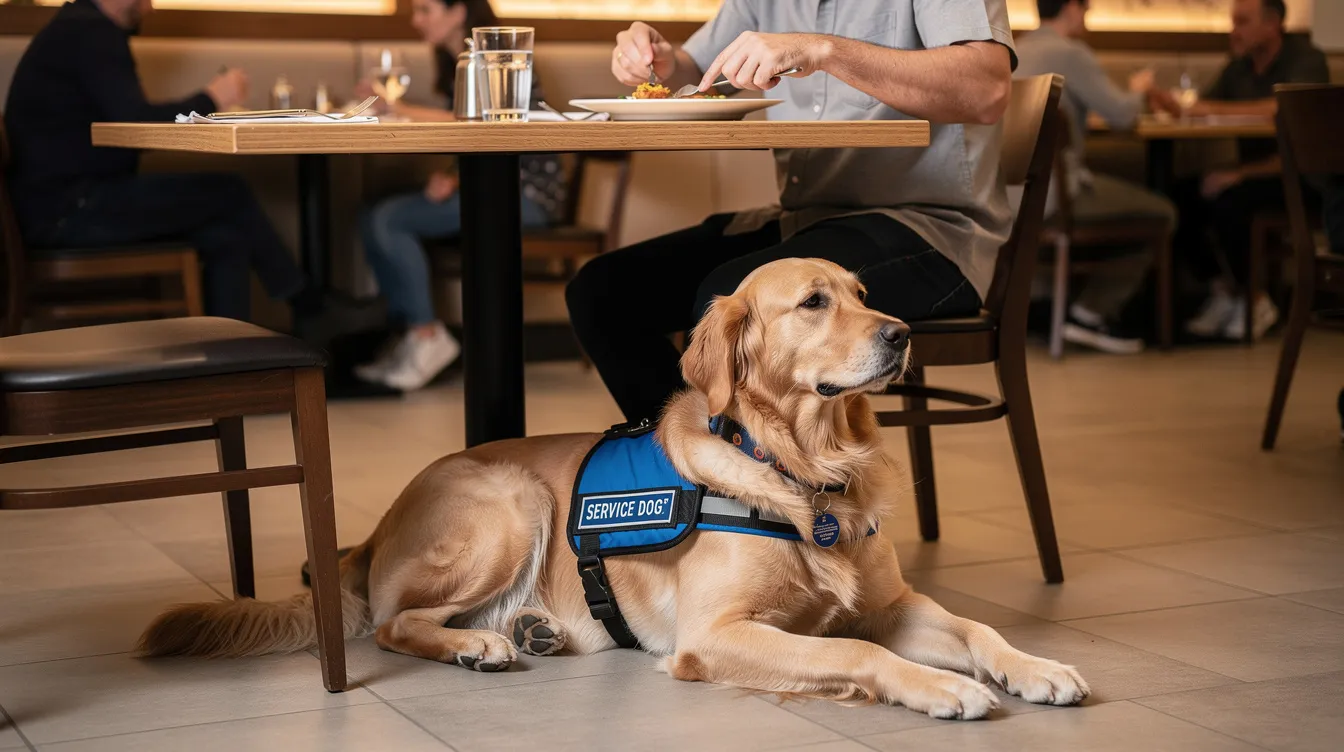
Indoor dining areas in restaurants, cafes, and bars
-
Hotel lobbies and guest rooms
-
Retail stores, shopping malls, and grocery stores
-
Movie theaters, gyms, banks, and museums
-
Taxis, rideshare vehicles, and public-facing offices
-
Public facilities like courthouses, polling places, and parks
A “no pets” policy does not apply to service dogs. Denying access to a service animal and handler based on such a policy violates the ADA. Businesses also cannot charge extra fees or deposits simply because a service animal is present.
In health care settings, service dogs are allowed in patient rooms, emergency departments, waiting rooms, clinics, cafeterias, and exam rooms. However, service dogs may be excluded from sterile environments like operating rooms or burn units, where the animal’s presence could compromise infection control.
Service dogs are also allowed in most municipal and state public facilities-libraries, city halls, courthouses, and public parks-under title ii. The only exception is when there is a specific, demonstrable safety or operational reason to exclude the animal.
Private clubs and many places of worship are exempt from ADA public accommodations rules and may set their own animal policies. However, some choose to follow ADA standards voluntarily or are covered by separate state or local laws.
How Do Title II and Title III of the ADA Affect Where Service Dogs Can Go?
ADA title ii covers state and local government programs and services, while title iii covers private businesses that function as public accommodations. Both require reasonable modifications to permit service animals.
Title II entities include:
-
City government offices and public schools
-
State universities and public transit systems
-
Police stations and public hospitals
-
Social service agencies and public recreation facilities
A public entity under Title II must allow a service dog to accompany its handler in public meetings, hearings, and recreational programs, ensuring equal access for all participants.
Title III entities include:
-
Restaurants, hotels, and motels
-
Retail stores, movie theaters, and museums
-
Stadiums, convention centers, and private schools
-
Doctors’ and dentists’ offices
Both titles require entities to modify “no pets” policies, train staff on the two permissible questions, and avoid blanket breed bans. A service dog may only be removed if the specific animal is out of control, not housebroken, or poses a direct threat that cannot be mitigated.
Religious organizations are not covered by Title III-even if they operate schools or daycares. However, if a religious organization leases space to a non-religious operator, that operator may still need to comply with ADA service animal rules. Such laws vary, and additional state protections may apply.
Are Service Dogs Allowed in Housing and Apartments?
Housing is primarily governed by the Fair Housing Act and, for federally funded programs, Section 504 of the Rehabilitation Act-not the ADA’s public access provisions. This distinction matters because housing law uses a broader category called “assistance animal.”
Under the fair housing act, landlords and property managers generally must permit both service dogs and other assistance animals (including emotional support animals) as a reasonable accommodation, even in “no pets” buildings. They cannot charge pet deposits or pet rent for these disability-related animals. Housing accommodations for a disabled person extend to apartments, condos, and many university dormitories.
If the individual’s disability or need for the animal is not obvious, housing providers may request reliable disability-related documentation. However, they cannot demand specific training certificates, registration, or other documentation, and they cannot restrict assistance animals by breed, size, or weight alone.
Assistance animals in housing must still behave appropriately. Landlords may impose reasonable rules about cleanliness, noise, and damage. An animal that poses a direct threat or causes substantial property damage-beyond what reasonable modifications can address-may be subject to removal.
Student housing and campus dorms typically function as housing rather than classrooms, so they are generally covered by the FHA. This means rules for emotional support animals and other assistance animals may be broader in housing than the ADA’s service dog-only standard that applies in classrooms and public spaces.
Can You Bring a Service Dog on Airplanes and Other Transportation?
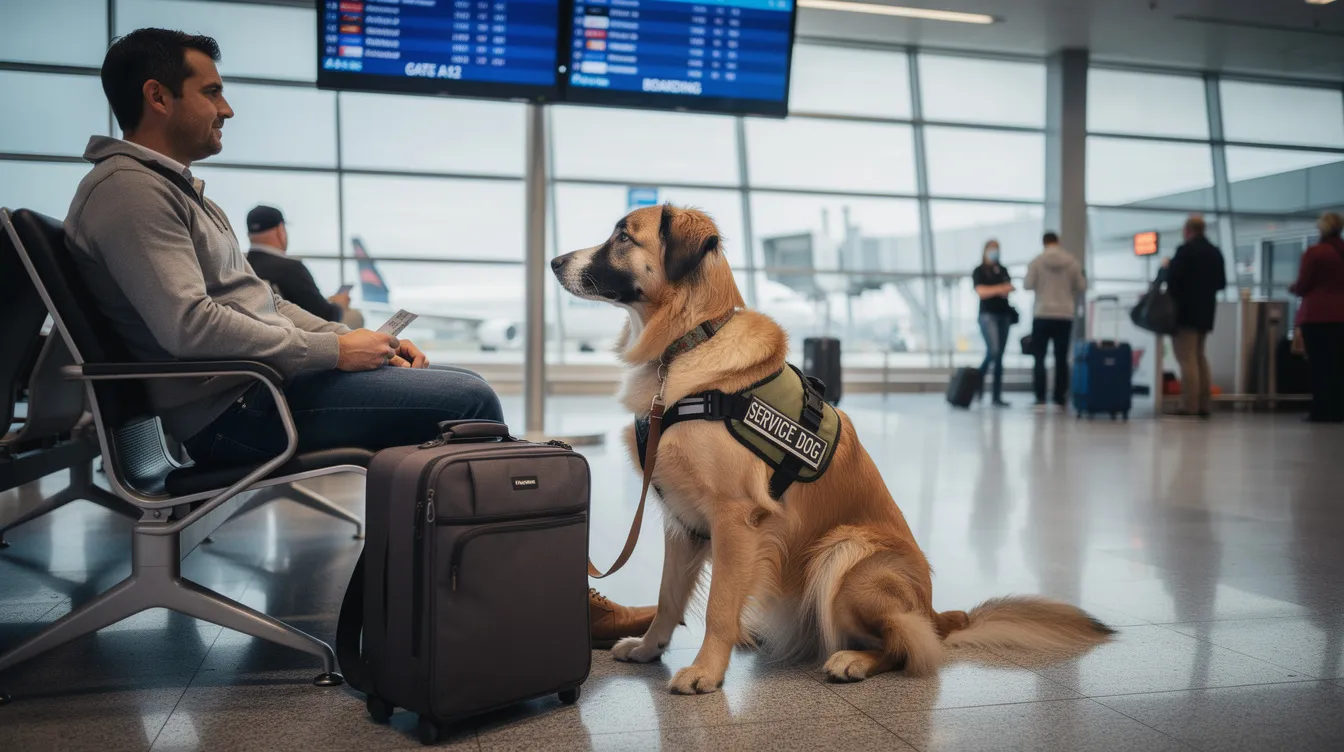
Air travel is governed by the Air Carrier Access Act (ACAA) and U.S. Department of Transportation regulations. Since January 2021, airlines must recognize only fully trained service dogs as service animals for flights. Emotional support animals and comfort animals must travel under the airline’s pet policy and no longer receive the same protections.
On U.S. carriers and many foreign airlines flying to or from the United States, a qualifying service dog may travel in the cabin at no additional charge. The dog must fit on the handler’s lap or in the handler’s foot space, and it must be trained to behave calmly in a crowded, confined environment. Airlines determine whether a specific animal meets these requirements and can deny transport if the animal poses a direct threat or exhibits disruptive behavior.
Airlines may require passengers to complete the U.S. DOT Service Animal Air Transportation Form-and, on longer flights, a relief attestation form-confirming the dog’s health, training, and behavior. Service animals in training and comfort animals typically must travel as pets.
For ground-based public transportation-including buses, subways, commuter rail, Amtrak, and paratransit-service dogs must be allowed in passenger areas under the ADA. Private taxis, shuttles, and rideshare drivers operating as public accommodations may not lawfully refuse rides because of a service dog.
Handlers should check both airline policies and destination-country import rules (vaccinations, quarantine, health certificates from disease control authorities) well in advance, as these can limit travel even for legitimate service dogs.
Are Service Dogs Allowed in Schools, Colleges, and Universities?
K–12 public schools are covered by ADA title ii and Section 504, while most colleges and universities fall under Title II or III plus Section 504 if they receive federal funds. These laws generally require allowing service dogs in classrooms and campus facilities.
Students with disabilities may bring a dog trained to perform disability-related tasks into classrooms, cafeterias, libraries, school buses, and extracurricular activities. Schools cannot insist that a staff member or parent “replace” the service animal’s tasks or claim that other persons on staff can provide the same assistance.
Emotional support animals are not entitled to classroom access under the ADA, but may be allowed in campus housing or under individualized education program (IEP) or Section 504 plans, depending on specific state and district rules. Such laws can vary significantly.
Schools and universities may impose reasonable behavior and hygiene expectations-the dog must be housebroken, non-aggressive, and under handler control. They can require advance coordination with disability services for relief areas, emergency procedures, or dorm allergy arrangements.
Consistent with ADA rules, schools may only ask the two permissible questions about whether the dog is a service animal required because of a disability and what task the dog performs. They cannot demand training certifications or require certification and must avoid blanket bans based on breed or size alone.
Can You Have a Service Dog at Work or During Job Interviews?
Employment settings are governed by ADA Title I, enforced by the Equal Employment Opportunity Commission (EEOC). Under Title I, a service dog-or, in some cases, an emotional support animal-may be considered a reasonable accommodation for a qualified individual with a disability.
Employees may request to bring a service dog to work if the dog helps them perform essential job functions or access the workplace. Examples include mobility assistance in a warehouse, seizure alert in an office, or a psychiatric service dog mitigating symptoms of mental illness like PTSD. Employers must engage in an interactive process to evaluate the request.
Employers may ask how the animal assists with work-related limitations and may request documentation of the disability if not obvious, but generally may not require specific certification of the dog’s training. The process should focus on the individual with a disability and the specific needs, not assumptions about the animal.
An employer can deny or modify an accommodation if having the dog at work would create undue hardship (significant difficulty or expense) or a significant risk to health or safety that cannot be reduced through reasonable adjustments. Concrete examples include sterile laboratories or environments where workers prepare food under strict sanitation protocols.
Practical strategies for success include written behavior policies, trial periods, designated relief areas, and clear agreements about the service animal’s safe management during the workday-benefiting both the employer and the employee.
What Behavior and Control Rules Apply to Service Dogs in Public?
Under ADA regulations, service dogs must be under the control of their handler at all times and must be housebroken. If they are not, businesses and public entities may lawfully ask that the dog be removed-even though the person with a disability must still be offered services without the animal.
Control generally means the dog is harnessed, leashed, or tethered. If the animal’s handler has a disability that makes those devices impossible, or the devices would interfere with the dog’s tasks, the dog must still respond to reliable voice commands, hand signals, or other controls.
Examples of unacceptable behaviors that can justify exclusion include:
-
Repeated barking in a restaurant or theater
-
Lunging or snapping at other persons or animals
-
Eliminating indoors inappropriately
-
Roaming freely through a store despite warnings
Staff must base decisions on the individual dog’s behavior-not stereotypes about breed or size-and should first ask the animal’s handler to regain control before requiring removal. If the dog is removed, the person must be offered services without the animal when feasible. A service animal handler’s right to access does not excuse destructive behaviors or disruptive behavior that threatens other patrons.
State and local laws may require licensing and vaccinations for all dogs, including service dogs. Handlers are responsible for ensuring compliance with general animal control and public health rules and managing their dog in a sanitary manner. This includes following regulations from local disease control authorities that apply to everyone.
When Can a Service Dog Be Excluded From a Place It Would Normally Be Allowed?
Under the ADA, there are only a few lawful reasons to exclude a service dog: when it is out of control and the handler does not take effective action, when it is not housebroken, when it poses a direct threat, or when the animal’s presence would fundamentally alter the nature of a service or program.
Concrete examples include:
-
Removing a dog that growls and snaps at patients in a clinic waiting room
-
Excluding a dog that repeatedly urinates on a grocery store floor
-
Barring animals (including service dogs) from a burn unit or sterile operating rooms because of infection control
A direct threat means a significant risk of substantial harm that cannot be reduced by reasonable modifications. This determination must be based on objective evidence about the specific dog’s behavior-not speculation about breeds or disabilities.
A “fundamental alteration” might include banning animals from a controlled laboratory where a dog’s presence would invalidate testing protocols, or from certain zoo enclosures where predator-prey dynamics would create unmanageable danger.
Inconvenience, mild allergies of other persons, or staff preferences are not valid reasons for denying access under the ADA. Instead, entities should consider solutions like adjusted seating arrangements, air filters, or alternative service windows. Simply being uncomfortable around dogs does not justify refusing service to a service animal user.
What Rules Apply to Miniature Horses Used as Service Animals?
ADA regulations explicitly recognize a miniature horse that is individually trained to perform tasks for people with disabilities. However, the ADA treats miniature horses differently than dogs, applying a separate four-factor test.
Miniature horses typically stand about 24–34 inches at the shoulder and weigh 70–100 pounds. Common uses include guide work for people who prefer a horse over a dog, stability support for individuals with balance impairments, and assistance for those with allergies to dogs. Like service dogs, miniature horses must be housebroken and under their handler’s control.
The four factors a public entity or business should assess are:
-
Whether the miniature horse is housebroken
-
Whether it is under the owner’s control
-
Whether the facility can physically accommodate its size and weight
-
Whether the horse’s presence compromises legitimate safety requirements
Practical examples: a courthouse might allow a miniature horse in public hearing rooms but not onto a narrow mezzanine; a small historic elevator may not safely accommodate the animal; a restaurant may still be able to fit the horse beside or under a table.
Public entities and businesses may have more leeway to deny access to miniature horses than to dogs when the four-factor analysis reveals genuine safety or space limitations.
How Do Service Dogs Differ From Emotional Support and Other Assistance Animals?
Understanding the distinction between a service dog, an emotional support animal, a therapy animal, and a broader assistance animal is critical because each category carries different legal rights in different settings.
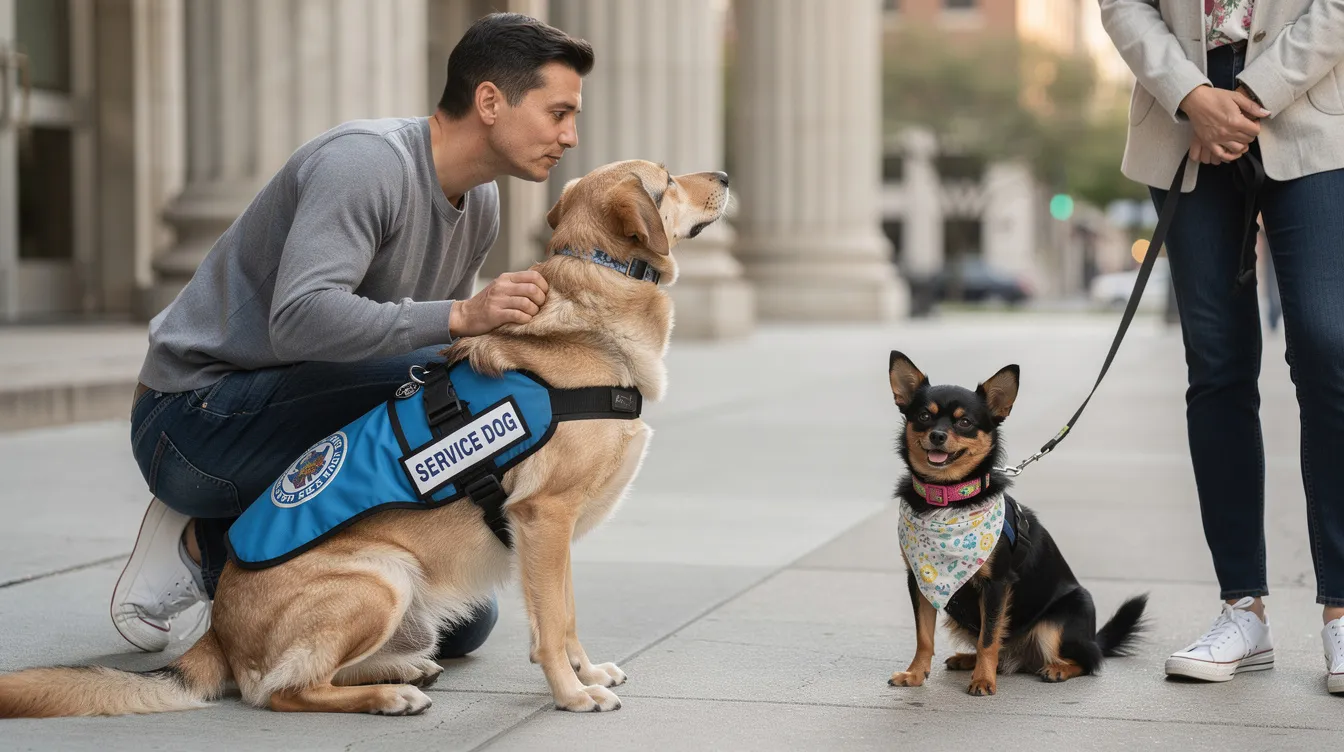
Service dogs (and some miniature horses) are task-trained animals with broad public access rights under the ADA. An emotional support animal provides comfort through its presence alone and does not qualify as a service animal under ADA public access rules. No other animal without specific task training receives ADA public access protection.
Therapy animals visit hospitals, schools, or nursing homes to comfort other people and have no independent legal right of access-they are allowed only where an institution permits them through its own program.
In housing, HUD uses the broader term “assistance animal” (sometimes called an assistance dog when it is a dog) to include both task-trained service animals and emotional support animals. But in public spaces like stores and restaurants, only ADA-defined service dogs and miniature horses must be admitted. An emotional support animal or other animal without task training can be lawfully denied entry to those spaces.
Labeling a pet as a “service dog” when it is not task-trained is not just ethically wrong-it can violate state fraud laws in many jurisdictions. Misrepresenting a pet as a service animal is illegal in most states and undermines trust in legitimate service animal users who rely on trained service dogs for full and equal access.
Frequently Asked Questions
Can a Hotel Refuse My Service Dog if They Have a "No Pets" Policy?
No. Under ADA Title III, hotels and motels must allow service dogs regardless of "no pets" policies. They cannot charge pet fees or deposits for a service animal required because of a disability. They may only charge for actual damage if they would charge any guest for similar damage. Staff may ask the two permissible questions-whether the dog is a service animal and what task the dog performs-but cannot demand registration papers, vests, or other documentation as a condition of entry. A guest with a service dog should never be denied entry or relocated solely because of the animal.
Are Service Dogs Allowed in Grocery Stores and Restaurants That Handle Food?
Yes. The ADA explicitly requires grocery stores, cafes, bars, and restaurants to admit service dogs into customer areas-even where local health codes prohibit pets-because federal disability law supersedes conflicting local "no animals" food-service rules. Only the working service dog may enter areas open to the public; service dogs may still be excluded from non-public spaces where employees prepare food under strict sanitation controls, such as commercial kitchens or food manufacturing areas.
Can Businesses Ask for Proof That My Dog Is a Service Animal?
Under the ADA, businesses and government entities cannot require medical records, identification cards, certification, or other documentation. They may only ask two questions: (1) Is the dog a service animal required because of a disability? (2) What work or task has the dog been trained to perform? Voluntary ID programs and vests exist but are not legally mandated-their absence cannot be used as grounds for refusing entry to a legitimate service dog and handler.
Do Service Dogs in Training Have the Same Access Rights as Fully Trained Dogs?
Under federal ADA rules, public access rights apply only to fully trained service animals-service animals in training are not covered under the ADA definition. However, many states have specific statutes granting public access rights to trainers and handlers of service dogs in training, often with conditions like leashing, wearing identifying tags, or carrying trainer credentials. If you are raising or training a future service dog, check your state's laws because rights vary significantly by jurisdiction.
What Happens if Someone Misrepresents a Pet as a Service Dog?
While the ADA itself does not set specific penalties, misrepresenting an animal as a service animal is a misdemeanor punishable under many state laws. For example, California law penalizes service dog fraud with fines up to $1,000. In Alabama, service dog fraud can lead to 100 hours of community service. Texas imposes civil penalties up to $250 for service animal misrepresentation. Misrepresenting a service animal is a Class C misdemeanor in many states. Beyond legal consequences, misrepresentation causes businesses to be more skeptical of legitimate teams-creating additional barriers and eroding trust for people who truly depend on a trained assistance dog.
References
- U.S. Department of Justice, Civil Rights Division. "ADA Requirements: Service Animals." ADA.gov, revised 2020. (Explains ADA service animal definition, public access rules, control requirements, and miniature horse provisions.)
- 28 C.F.R. § 35.104 and § 35.136 (2020). U.S. DOJ regulations implementing Title II of the ADA for state and local government services, including service animal definitions and access rules.
- 28 C.F.R. § 36.104 and § 36.302(c) (2020). U.S. DOJ regulations implementing Title III of the ADA for public accommodations, detailing service animal access, permissible inquiries, and grounds for exclusion.
- U.S. Department of Housing and Urban Development (HUD). "Assessing a Person's Request to Have an Animal as a Reasonable Accommodation Under the Fair Housing Act." FHEO‑2020‑01, January 28, 2020. (Clarifies treatment of service and assistance animals in housing.)
- U.S. Department of Transportation. "Traveling by Air with Service Animals; Final Rule." 14 C.F.R. Part 382, effective January 4, 2021. (Defines service animals for air travel and outlines airline obligations and DOT service animal forms.)
- U.S. Equal Employment Opportunity Commission (EEOC). "Enforcement Guidance on Reasonable Accommodation and Undue Hardship under the ADA," with sections addressing service animals as workplace accommodations.
- ADA National Network / Great Lakes ADA Center. "Service Animals and Emotional Support Animals: Where Are They Allowed and Under What Conditions?" (Educational guidance on differences between service animals and ESAs across settings.)

Pet Slimmers Editorial Team
The Pet Slimmers editorial team writes practical, evidence-based guidance on companion animal weight management, drawing on the work of the ROYAL CANIN® Weight Management Clinic at the University of Liverpool.
This article is for general information only and is not a substitute for professional veterinary advice. Always consult your veterinary surgeon about the health of your pet.