Flying With a Service Dog: Complete 2026 Guide to DOT Rules, Airline Forms & In-Cabin Travel
Key Takeaways
- Flying with a service dog is regulated by the U.S. Department of Transportation under 14 CFR Part 382. Only dogs that are individually trained to perform tasks for a qualified individual with a disability qualify as service animals for air transportation. Emotional support animals are not recognized as service animals under federal airline rules.
- Most airlines are required to accept up to two service animals per qualified traveler in the cabin at no charge when DOT Service Animal Air Transportation Forms are properly completed. Airlines typically require submission at least 48 hours before departure.
- Travelers must use the official DOT Service Animal Air Transportation Form. For flights over 8 hours, a second DOT form, the Service Animal Relief Attestation, is also required. Making false statements on these forms is a federal crime under 18 U.S.C. § 1001.
- Airlines determine at the airport whether a dog is a service animal based on behavior, training documentation, and limited questions. They can deny boarding if the dog poses a direct threat to health or safety, or causes a significant disruption that cannot be resolved.
- This article provides general information about flying with a service dog in 2026, not legal advice. Rules can vary by airline, destination country, and individual circumstances.
Only fully trained service dogs qualify as service animals for air transportation under current U.S. Department of Transportation rules. Emotional support animals, therapy animals, and comfort animals must travel under each airline’s pet policy. This guide covers every step of flying with a service dog in 2026, from filling out the correct federal forms to boarding and seating.
What counts as a service dog when flying in 2026?
A service animal for air transportation is a dog individually trained to do work or perform tasks for a qualified individual with a disability. This definition comes from the DOT’s 14 CFR Part 382 rules, effective since January 11, 2021. Only dogs qualify; other species, including miniature horses (which have limited ADA access on the ground), are excluded from cabin service on aircraft.
Acceptable tasks include guiding a person who is blind, alerting a deaf handler to sounds, seizure response, mobility assistance like balance support, and psychiatric tasks such as interrupting self-harm or grounding during a PTSD episode. Mere presence, emotional comfort, or companionship without a specific trained task does not meet the DOT definition.
“Flying with a service dog” under DOT rules means the dog is fully trained before travel. Service animals in training are not covered by federal air travel protections. Some airlines voluntarily allow trainers to travel with dogs in training under modified pet policies, but this is not guaranteed.
The DOT’s service-animal-only definition is narrower than what the Air Carrier Access Act historically allowed. Before 2021, airlines sometimes accepted emotional support animals under the ACAA. The ADA covers airports, terminals, and ground services, not the aircraft cabin itself. At the gate and in the terminal, ADA rules apply; once you board, DOT and the ACAA govern.
Neither the ADA nor the DOT require federal registration, certification cards, vests, or ID tags. Airlines must accommodate trained service dogs that assist individuals with disabilities based on training and task performance, not based on paperwork sold by online registries.
How did DOT rules change for emotional support animals?
Since the DOT’s final rule took effect on January 11, 2021, emotional support animals are treated as pets for air travel. Airlines no longer must accept ESAs under service animal rules, even when a mental health professional has provided a letter.
Emotional support, comfort, and companionship animals are not recognized as service animals for air transportation, regardless of how they support a documented mental disability. A person with PTSD may fly with a psychiatric service dog trained for specific tasks like interrupting dissociative episodes; that same person cannot fly with an untrained ESA cat under the service animal rules. The ESA cat would need to travel under the airline’s standard pet policy, with associated fees, carrier requirements, and possible route restrictions.
Travelers with emotional support animals must check each airline’s pet policy individually. Fees, size limits, carrier dimensions, and breed restrictions vary. Some airlines restrict pets on certain routes or when a trip includes a partner airline segment.
Many older articles still reference pre-2021 ACAA rules. Delta, for example, stopped accepting emotional support animals in January 2021 and began requiring DOT documentation for trained service dogs only. Always verify current policies before booking.
What disability laws apply when you fly with a service dog?
Two federal laws govern different parts of the travel experience. The Air Carrier Access Act and DOT regulations under 14 CFR Part 382 control what happens on the aircraft and during boarding. The Americans with Disabilities Act covers airports, terminals, ticket counters, and security checkpoints.
All U.S. air carriers and foreign airlines operating flights to or from the United States must comply with the DOT’s service dog rules. Foreign carriers may also have additional requirements under their own national regulations, so checking with each airline is necessary for international routes.
ADA rules still matter in airport areas. Security screening, check-in counters, waiting areas, and airport restaurants must allow service dogs under ADA standards. The ADA definition of a service animal is similar to the DOT’s but not identical; for example, the ADA recognizes miniature horses in limited ground-access contexts, while the DOT does not.
State service animal statutes may add protections in airports (some states cover service animals in training, for instance), but state law does not override federal DOT regulations about who can bring animals into the aircraft cabin.
This legal overview is informational. Travelers with complex situations, such as cross-border flights or multiple disabilities, may benefit from consulting a disability rights attorney or an advocacy organization.
What is the DOT Service Animal Air Transportation Form?
The United States Department of Transportation created a standardized form so airlines can verify that a dog is a trained service animal, is healthy, and will behave properly in flight. Airlines require specific federal forms for flying with a service dog; proprietary airline forms that duplicate this DOT content are not permitted for U.S. domestic flights.
The DOT service animal form includes these sections:
|
Section |
What it covers |
|---|---|
|
Handler information |
Passenger name, contact details |
|
Service dog description |
Breed, weight, microchip number |
|
Health and vaccine attestation |
Confirmation of the service animal’s health and current vaccinations |
|
Behavior and training attestation |
Statement that the dog is trained, has no history of aggressive behavior, and is under handler control |
|
Handler responsibilities |
Acknowledgment of leashing, damage liability, and cleanup obligations |
Airlines required to use the DOT form must provide it on their websites and accept it electronically or as a hard copy. The current version (OMB Control Number 2105-0576) has an expiration date of September 30, 2027.
A second DOT form is required for flights lasting 8 hours or longer. The Service Animal Relief Attestation confirms that the dog can either go without relieving itself for the flight duration or can do so hygienically in the cabin. Submit the Service Animal Relief Attestation for flights over 8 hours along with the primary form.
Making false statements on a DOT service animal form is punishable under 18 U.S.C. § 1001. Be honest about training status, the service animal’s health, vaccination records, and any prior aggressive behavior.
How and when should you submit DOT service animal forms?
Submit the DOT Service Animal Air Transportation Form 48 hours before travel when your reservation is booked more than 48 hours in advance. Most airlines accept submissions through their accessibility or special assistance portals online. Use the Service Animal Forms Portal (where available on the airline’s website) for streamlined processing.
A typical submission flow looks like this:
-
Book your ticket and note the confirmation number.
-
Navigate to the airline’s disability or accessibility page.
-
Select the option for traveling with a service animal.
-
Upload or attach the completed DOT form (PDF). You may need Adobe Acrobat Reader to fill out the official PDF before uploading.
-
For flights over 8 hours, attach the Relief Attestation form as well.
-
Save or screenshot the confirmation.
Some carriers allow travelers who have an existing, approved DOT form on file to reuse it for future trips with the same service dog. Others require a fresh submission for each itinerary. American Airlines, for example, issues a “Service Animal ID” (SVAN ID) after initial approval, which simplifies rebooking.
If a ticket is booked less than 48 hours before departure, airlines are generally required to accept the DOT form at the airport. Still, arrive early to avoid delays; last-minute paperwork processing can take extra time at the check-in counter.
When any flight segment is on a partner airline, contact that partner airline directly. Airlines determine their own intake process, and a partner airline may require separate submissions or have different documentation requirements for service animals traveling on their aircraft.

How do airlines determine if your dog qualifies as a service animal?
Airlines determine whether a dog is a service animal based on DOT service animal forms, observed behavior at the airport and gate, and limited questions to the handler. Airlines generally cannot require additional disability documentation beyond DOT forms.
Behavior airline staff look for:
-
Remaining under the handler’s control at all times
-
Staying leashed, harnessed, or tethered
-
No uncontrolled barking, lunging, or wandering
-
No soiling in public areas without handler cleanup
-
No jumping on other passengers or staff
Staff may ask two questions: (1) Is the dog required because of a disability? (2) What tasks has the dog been trained to perform? They should not probe for a specific diagnosis or demand a doctor’s letter beyond what the DOT form already covers, even when the handler has a mental disability or a non-obvious condition.
Airlines may deny boarding as a service dog if the animal displays aggressive behavior, is excessively disruptive, is too large to fit safely in the handler’s foot space, or lacks required documentation for international or high-risk destinations. If a dog lunges at a gate agent during boarding, for example, the airline may reclassify the dog as a pet and apply standard pet rules, including fees and carrier requirements.
Each airline must have a complaints resolution official available. If you believe your rights under the ACAA have been violated, ask to speak with this person before leaving the airport.
How to prepare your service dog before the travel day
Preparation weeks before departure can reduce stress and help your dog succeed in the crowded, noisy environments of airports and aircraft cabins.
Concrete pre-flight training to practice:
-
Long down-stays in tight spaces (under restaurant tables, in crowded waiting rooms)
-
Ignoring food dropped on the floor
-
Remaining calm near rolling luggage, automatic doors, and escalators
-
Tolerating loud, sustained noise similar to jet engines
Handlers must comply with health and vaccination requirements for traveling with service dogs. Confirm that vaccinations, parasite prevention treatments, and microchip registration are current before the trip. Some destinations and high-risk countries require rabies titers, specific vaccine timing, or additional veterinary certificates.
Gradually introduce your service dog to any gear that will be used during travel: soft harness, muzzle (if required by the destination country), relief pads, and booties for walking on hot tarmac. Familiarity reduces stress on travel day.
Assemble a “service dog travel folder” with:
-
Printed copies of all necessary forms (DOT Air Transportation Form, Relief Attestation if applicable)
-
Veterinary health records and rabies certificates
-
Microchip documentation
-
Any import permits required for specific countries, U.S. territories like Hawaii, or your mobile device backup of digital copies
What to expect at the airport when flying with a service dog
The travel day sequence when flying with a service dog follows the same general pattern as any flight, with a few additional steps at check-in, security, and boarding.
Check-in: The agent may verify your DOT service animal forms and ask brief questions about the dog’s tasks or training. Some airlines note “SVAN” or a similar service animal code in the reservation. If you submitted forms in advance through the airline’s portal, this step is usually quick.
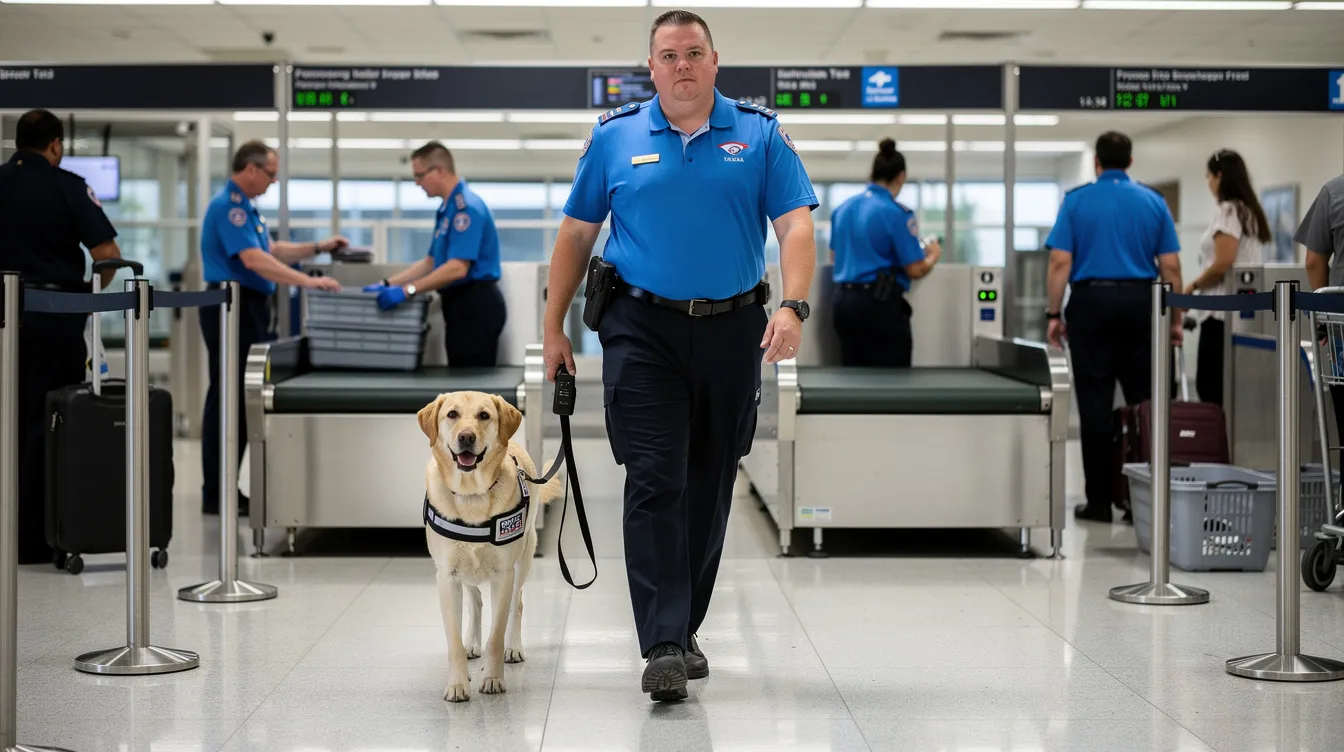
TSA security: TSA recommends contacting them 72 hours before your flight if you have questions about screening procedures. At the checkpoint, you may need to remove metal gear (collars, harnesses with buckles) if requested. Walk the dog through the metal detector on leash. Handlers and gear may be swabbed. Pack travel-sized liquids in a quart-sized bag for security, just as you would on any flight; this applies to any liquids you carry for the dog as well (eye drops, medication).
Finding relief areas: Under DOT rules, airports must provide service animal relief areas. Look for signage in the terminal, check the airport’s website, or use the airport’s app to locate relief stations before boarding and after arrival.
Gate and boarding: Keep the dog settled at your feet while waiting. Many airlines offer pre-boarding to passengers with service dogs, which gives you time to position the dog before the main boarding rush. Proactively inform gate agents about any seating needs, especially if the dog is large.
Where can your service dog sit on the plane?
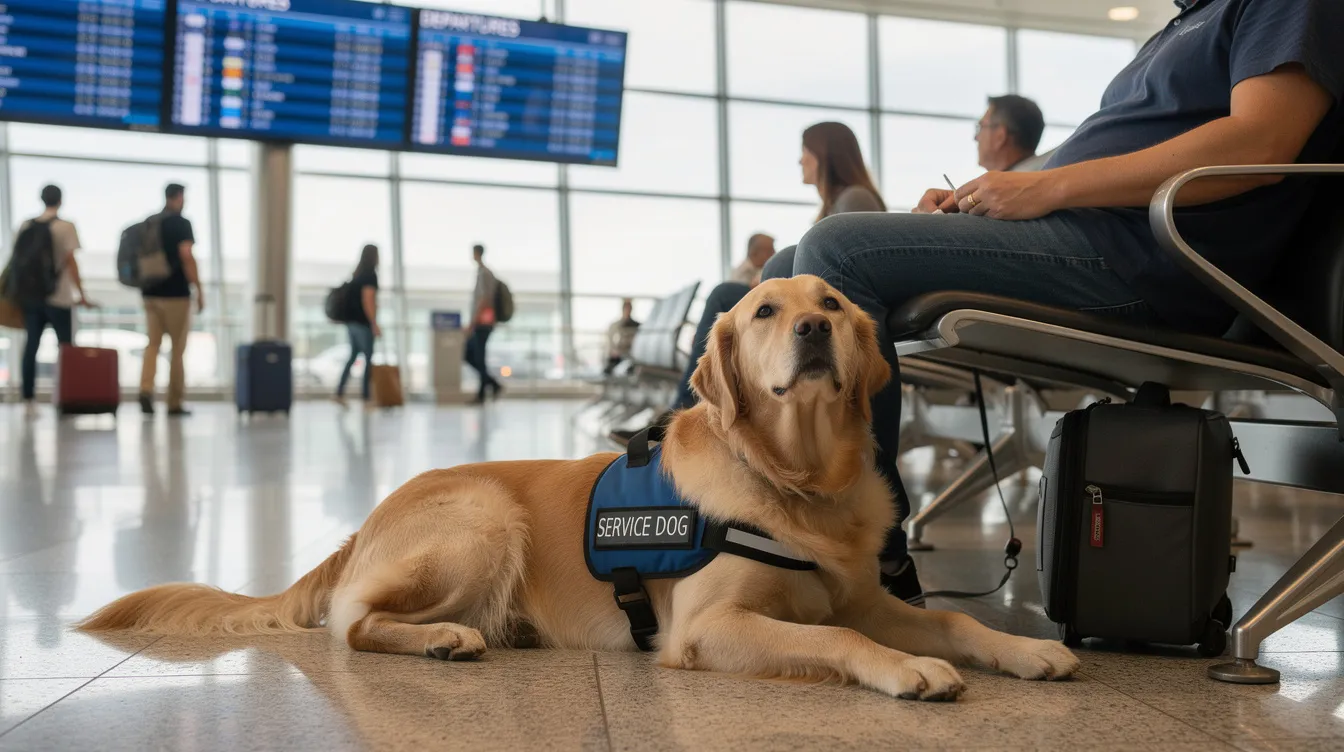
Service dogs must remain at the handler’s feet or in their lap (if the dog is small enough) during the flight. They cannot occupy their own seat, and the aisle and emergency equipment access must remain unobstructed.
Airlines will not permit service dogs in an exit row because the dog could interfere with emergency evacuation procedures. Bulkhead seats may also be restricted if the floor space cannot safely accommodate the dog without blocking tray tables or crew access.
Seating differences by cabin class:
-
Standard economy: The dog fits in the foot space between the seat base and the seat in front.
-
Extra-legroom seats: More floor space, which is helpful for larger dogs.
-
Premium cabins (business class, suites): Layouts vary; some have enclosed suites where the dog fits on the floor, while others have angled seats that reduce usable foot space.
Service dogs must be leashed, harnessed, or tethered at all times during travel. Attach the tether to your body or seatbelt buckle, not to the aircraft structure. If the leash or harness interferes with the dog’s task performance, voice or signal control may be acceptable.
If the dog is too large to fit safely within the handler’s foot space even after reseating options are explored, the airline may decline in-cabin carriage under DOT safety requirements. In that case, cargo transport under the airline’s pet cargo rules (with fees) may be the only alternative.
International routes, partner airlines, and high-risk destinations
Flying with a service dog across borders adds layers of complexity: national animal import rules, partner airline policies, and sometimes quarantine or pre-approval timelines that stretch months ahead of travel.
Travelers coming from or going to countries the CDC designates as high-risk countries for dog rabies must follow CDC dog import rules. These can include special permits, proof of rabies vaccination administered at specific intervals, and entry through designated U.S. ports. Service dogs must meet CDC vaccination and microchip requirements to fly into the United States. Complete the CDC Dog Import Form for U.S. entry when returning from or arriving from covered countries.
Check both the departure and arrival country’s agriculture or veterinary ministry websites for current rules. Some countries require world screwworm or tapeworm treatment certificates, ISO-standard microchips, or waiting periods after vaccination before dogs entering their borders are cleared.
When itineraries involve a partner airline, that carrier may have stricter service dog rules or may limit in-cabin dogs on certain aircraft types. Contact each airline in the chain directly. A single itinerary booked through one airline does not guarantee uniform service animal acceptance across all segments.
Some islands and rabies-free regions, including Hawaii and certain international destinations, require long lead-time paperwork (sometimes 120+ days), blood titer tests, and arrival inspections. These rules apply even when the dog is a trained service animal.
Health, safety, and behavior standards for service dogs in flight
Airlines required to transport trained service animals can still deny or remove a dog that poses a direct threat to health or safety or causes a significant disruption that cannot be mitigated by reasonable measures.
Examples of disruptive behavior that can lead to denial or removal:
-
Repeated uncontrolled barking or growling
-
Snapping at passengers, crew, or other animals
-
Roaming the cabin unsupervised
-
Jumping on passengers
-
Soiling the cabin or gate area without the handler taking reasonable cleanup steps
Service dogs must not display disruptive behavior during travel. Service dogs must behave properly in public during travel, including in terminals, boarding areas, and onboard. Handlers are responsible for the dog’s feeding and relief schedule. Many experienced handlers limit food intake a few hours before departure while keeping water available and administering any necessary medications on schedule.
Carry cleaning supplies: waste bags, absorbent pads, and disinfectant wipes. If medically appropriate, discuss with your veterinarian whether the flight is safe for very young, elderly, pregnant, or medically fragile dogs before booking.
If behavior problems arise in flight, cabin crew may move the handler and dog to a different location, ask the handler to better control the animal, or, if safety is compromised, treat the dog as a pet on future segments or refuse further carriage. Airlines can deny boarding if a dog poses a direct health or safety threat at any point in the journey.
Common mistakes and how to avoid problems when flying with a service dog
Most travel problems arise from paperwork errors, unrealistic expectations about the dog’s readiness, or confusion about what all the requirements actually include.
Frequent mistakes:
-
Submitting an incomplete DOT form (missing microchip number, unsigned attestation, wrong dates)
-
Waiting until the airport to mention the service dog instead of providing notification up to 48 hours in advance
-
Assuming emotional support animals qualify as trained service animals
-
Ignoring country-specific animal import rules for international legs
-
Relying on a paid ID card or online “certification” instead of the official DOT form
How to avoid them:
-
Double-check names, microchip numbers, and vaccination dates on every form before submission.
-
Save digital copies on your mobile device and carry printed backups.
-
Confirm airline notes on the reservation 24 hours before departure.
-
Notify airlines about your service dog 48 hours in advance (or as early as possible).
-
If any segment involves a partner airline, contact them separately.
If the dog is still in training or reactive in crowds, consider postponing air travel or working with a qualified trainer before booking. Realistic assessment of the dog’s readiness protects both the handler and other passengers.
Misrepresenting a pet as a service dog can lead to denied boarding, fines under 18 U.S.C. § 1001, and legal consequences in states with fraud statutes. It also invites stricter enforcement policies that ultimately harm legitimate service dog users.
Disclaimer
This article offers general educational information about flying with a service dog and Department of Transportation service animal rules as of 2026. It does not constitute legal, medical, or veterinary advice. Airline policies, DOT regulations, CDC rules, and foreign import requirements can change on short notice. Verify details with your airline, relevant government agencies, and qualified professionals before traveling.
Frequently Asked Questions
Do I have to register my service dog or buy an ID card before flying?
Neither the DOT, the ACAA, nor the ADA require any federal registration, online certification, or ID card for a service dog. Airlines rely on the official DOT service animal forms and the dog's observed behavior. Paid "certificates" or registries sold online provide no legal benefit of a qualified service animal status and do not guarantee airline acceptance. Save your money and complete the free DOT form instead.
How many service dogs can I bring on a flight?
DOT guidance allows up to two service animals per qualified traveler in the cabin, provided both dogs fit safely in the foot space. Confirm the exact limit with your chosen airline before booking, as some carriers may have operational restrictions on certain aircraft types.
Can my service dog fly in the cargo hold instead of the cabin?
DOT rules assume service dogs travel in the cabin with their handlers. Service dogs can fly in the cabin at no charge under these rules. If a handler voluntarily chooses cargo transport, the airline's standard pet cargo rules, fees, and seasonal restrictions apply. Service animal protections under the ACAA do not extend to voluntary cargo carriage.
What if my disability is not obvious; will I need a doctor's letter?
For most U.S. flights, airlines rely on the DOT Service Animal Air Transportation Form rather than a separate doctor's letter. Staff may ask what tasks the dog performs but should not demand disclosure of specific diagnoses. Additional medical documentation may be required only where DOT regulations or foreign entry rules explicitly call for it.
Can airlines charge me a fee for my service dog?
Airlines are not allowed to charge extra fares or pet fees for qualified service dogs or their essential assistive equipment. Standard baggage rules still apply for non-essential items you carry for the dog. Review each carrier's accessibility policies for precise details, especially for provide assistance with oversized equipment or supplies.
References
- U.S. Department of Transportation, "Traveling by Air with Service Animals," Final Rule, 14 CFR Part 382, Federal Register Vol. 85 No. 238, December 10, 2020; effective January 11, 2021.
- U.S. Department of Transportation, "U.S. Department of Transportation Service Animal Air Transportation Form," OMB Control No. 2105-0576, Final Version September 20, 2024; and "Service Animal Relief Attestation Form," published on transportation.gov.
- U.S. Department of Justice, Civil Rights Division, "ADA Requirements: Service Animals," ADA.gov Frequently Asked Questions and technical assistance documents.
- Centers for Disease Control and Prevention (CDC), "Bringing a Dog into the United States," current dog import rules and high-risk country designations.
- Centers for Disease Control and Prevention (CDC), "Rabies in Dogs: Information for Travelers," guidance on international dog travel, vaccination, and disease control requirements.
- U.S. Department of Transportation, Aviation Consumer Protection Division, "Passengers with Disabilities," ACAA enforcement guidance and complaint filing procedures.

Pet Slimmers Editorial Team
The Pet Slimmers editorial team writes practical, evidence-based guidance on companion animal weight management, drawing on the work of the ROYAL CANIN® Weight Management Clinic at the University of Liverpool.
This article is for general information only and is not a substitute for professional veterinary advice. Always consult your veterinary surgeon about the health of your pet.