Psychiatric Service Dog: Laws, Tasks, and How to Get One
Key Takeaways
- A psychiatric service dog is a service animal under the ADA (42 U.S.C. §12101; 28 C.F.R. §35.104, §36.104). It must be individually trained to do work or perform tasks directly related to a psychiatric disability. The ADA does not require certification, registration, vests, or ID cards - only a qualifying disability and reliable task training.
- PSDs can help people with anxiety disorders, panic disorder, post traumatic stress disorder, bipolar disorder, major depression, and other serious mental health conditions when those conditions substantially limit major life activities.
- Core benefits include symptom interruption, applying deep pressure therapy during anxiety attacks, medication reminders, waking handlers from nightmares, interrupting self-harm behaviors, and in some cases providing balance assistance when psychiatric medications cause dizziness.
- Federal protections cover public access (ADA), housing (Fair Housing Act), and air travel (Air Carrier Access Act), but laws differ slightly by state. Some states impose penalties for misrepresenting pets as service animals.
- This article is general information, not legal advice. For your specific situation, consult a licensed attorney, mental health professional, or accredited trainer.
A psychiatric service dog is a service dog individually trained to perform specific tasks for a person with a qualifying psychiatric disability. Unlike emotional support animals, a psychiatric service dog must be task-trained under the Americans with Disabilities Act, and it carries full public access rights in restaurants, stores, and other spaces where pets are not allowed.
What Is a Psychiatric Service Dog?
A psychiatric service dog is a type of service dog specifically trained to perform tasks for a person with a qualifying psychiatric disability. Common qualifying conditions include post traumatic stress disorder, panic disorder, major depressive disorder, and bipolar disorder.
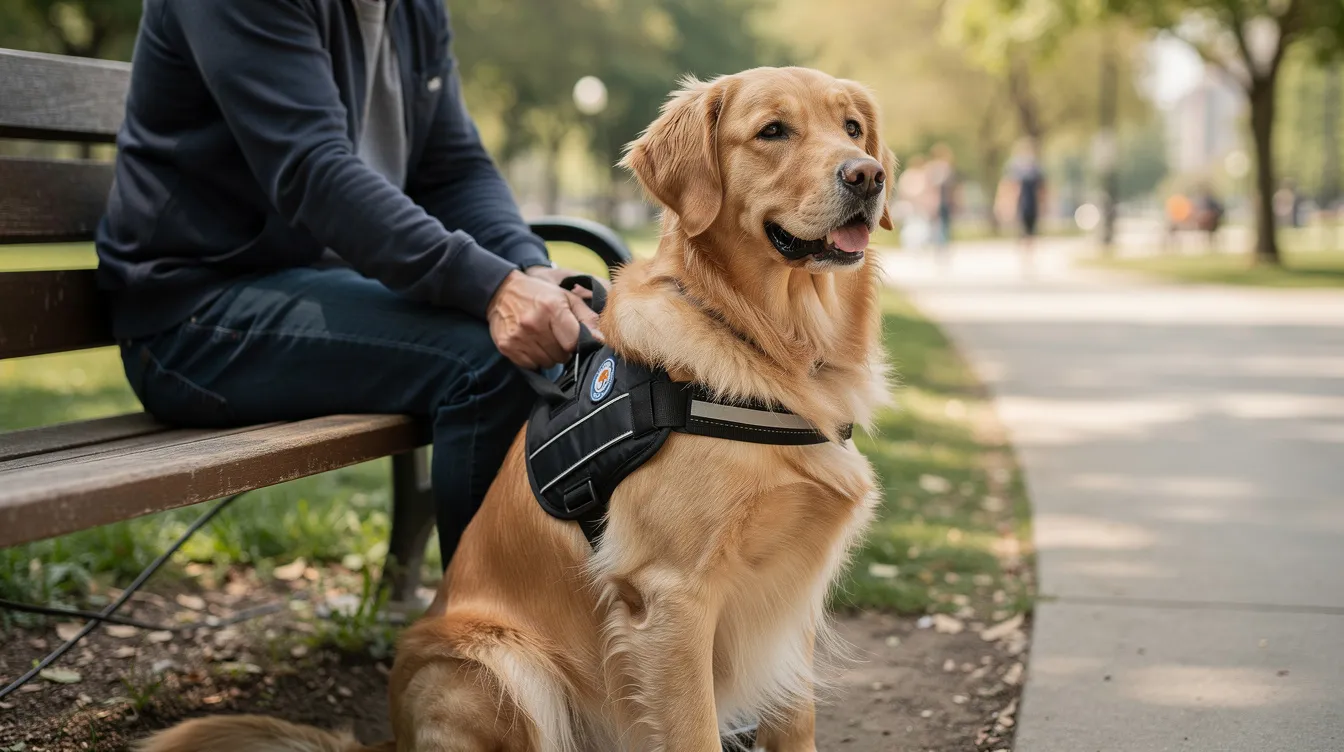
Under the Disabilities Act, a psychiatric service dog is treated identically to any other service animal. The dog must be individually trained to do work or perform specific tasks directly related to the handler’s disability. Simply providing emotional support or companionship does not meet this standard.
What does task training look like in practice? A psychiatric service dog might ground someone during a panic attack by applying pressure to their lap, interrupt repetitive behaviors or self-harm urges with a trained nudge, guide the handler to a quiet exit during sensory overload, or retrieve medication during a depressive episode. These are deliberate, trained responses – not instinctive comfort.
Federally, psychiatric service animals can only be dogs (with a narrow provision for miniature horses in some settings). Cats, birds, and other species do not qualify as service animals under the ADA, regardless of how helpful they may be.
Over 1 in 5 Americans live with a mental health illness, and many of them have invisible disabilities. That invisibility is precisely why education about the role and legal standing of psychiatric service dogs matters so much.
How Do Psychiatric Service Dogs Differ From Emotional Support Animals?
The most important distinction is simple: a psychiatric service dog is trained to perform tasks that directly mitigate a disability. Emotional support animals provide comfort through their presence alone, without specific task training. That single difference determines nearly everything about legal rights and public access.
Here are the three key differences:
|
Feature |
Psychiatric Service Dog |
Emotional Support Animal |
|---|---|---|
|
Task training required |
Yes – must perform specific tasks |
No – comfort by presence |
|
Public access (ADA) |
Yes – restaurants, stores, transit |
No |
|
Housing (FHA) |
Yes – reasonable accommodations |
Yes – with clinician letter |
|
Air travel (ACAA, post-2020) |
Yes – no extra fees |
Generally treated as pets |
Emotional support dogs and other emotional support animals can still play a meaningful role in mental health care. They provide companionship, routine, and genuine comfort. But they are not recognized as service animals under ADA regulations and cannot accompany their owners into public spaces where pets are restricted.
After the 2020 DOT rule changes, airlines must generally accommodate psychiatric service dogs in the cabin without extra fees. Emotional support animals, however, are typically treated as pets – subject to airline pet policies, fees, and carrier requirements.
No federal law requires registration, certification, or an ID card for either PSDs or ESAs. Online “registries” that sell certificates or ID cards do not grant any extra legal rights. The ADA does not require service dogs to have specific certifications, registrations, or vests.
What Mental Health Conditions Can a Psychiatric Service Dog Help With?
The key legal requirement is not a specific diagnosis label. What matters is that the person has a psychiatric condition that substantially limits one or more major life activities – things like sleeping, concentrating, working, or leaving the house.
To qualify for a PSD, you need a diagnosed mental illness, and that mental illness must significantly impair daily life activities. Anxiety is the most common mental illness worldwide, and severe anxiety that prevents someone from grocery shopping, riding public transit, or holding a job can certainly meet this threshold. Conditions must significantly impair major life activities to qualify.
Common qualifying conditions include:
-
Severe anxiety disorders, including panic disorder and social anxiety, where a PSD can alleviate anxiety by providing grounding during an anxiety attack or leading the handler away from overwhelming situations
-
Post traumatic stress disorder, where PSDs can wake handlers from nightmares, provide “cover” by watching behind them, and interrupt flashbacks – PTSD is a common condition for psychiatric service dogs
-
Bipolar disorder, which qualifies for a psychiatric service dog when mood episodes impair functioning; PSDs can provide medication reminders and routine structure
-
Major depressive disorder, especially severe depression where getting out of bed or performing basic self-care becomes a struggle
-
Obsessive-compulsive disorder, where PSDs can interrupt repetitive behaviors or compulsive rituals with a trained alert
-
Schizophrenia, which can qualify for a psychiatric service dog when symptoms like paranoia or disorganization substantially limit independence
Autism spectrum disorder and certain developmental conditions may also qualify when psychiatric symptoms or overwhelming sensory overload issues are present.
A licensed mental health professional – not the dog trainer – should determine whether the person’s condition meets the legal standard of a psychiatric disability. Dog trainers can advise on training, but clinical eligibility is a clinical decision.
What Tasks Can a Psychiatric Service Dog Perform?
Psychiatric service dog tasks must be directly linked to the handler’s disability and reliably trained. The dog must be trained to perform tasks that directly mitigate the handler’s psychiatric symptoms. “Just being there” is considered emotional support, not a task.
Tasks generally fall into several groups:
Alert and interrupt tasks. PSDs can interrupt self-harm behaviors during episodes by nudging the handler, pawing at their arm, or placing their head in the handler’s lap. They can also alert to rising anxiety before a full-blown panic attack develops. Research with veterans found that handlers used trained tasks an average of 3.16 times per day, with the highest-frequency tasks being anxiety calming and anxiety alerting.
Grounding and tactile stimulation. During panic attacks or dissociative episodes, a PSD can provide deep pressure therapy by leaning against the handler or lying across their lap. Applying deep pressure therapy during an anxiety attack can reduce heart rate and blood pressure, helping the handler regain a sense of physical contact with reality. Studies report that roughly 94% of psychiatric assistance dog handlers use tactile stimulation for anxiety.
Safety and navigation tasks. Psychiatric service dogs guide handlers to safe exits when experiencing disorientation. They help create a physical barrier in crowded environments by positioning themselves between the handler and others, protecting personal space. A PSD can enter a room first to check for safety, reducing hypervigilance – essentially conducting room searches for safety checks.
Monitoring and reminder tasks. PSDs can remind handlers to take medication at set times, persist until the handler takes them, and fetch a phone during a crisis. Retrieving medication or a crisis kit is a trained response, not instinctive behavior. They can also alert to alarms or doorbells when sedation or dissociation makes the handler unresponsive.
Physical support tasks. Some psychiatric service dogs provide light balance assistance or balance support when a handler’s medications cause dizziness on stairs or uneven ground. This requires a physically appropriate, mature dog with sufficient body weight and careful veterinary oversight.

How Do Psychiatric Service Dogs Support Daily Mental Health Care?
Psychiatric service dogs play a role within a broader mental health care plan, alongside therapy, medication, and lifestyle strategies. They are one tool – not a replacement for clinical treatment.
For people with severe depression or bipolar disorder, a PSD can help structure the day in concrete ways: morning walks that require the handler to get out of bed, cues for meals and self-care, and built-in reminders for appointments. PSDs are trained to perform specific tasks related to psychiatric conditions, and these routine-building tasks are often underappreciated.
PSDs also reduce avoidance. A person with severe anxiety about crowded grocery stores can rely on their PSD to provide crowd buffering, interrupt escalating panic, and facilitate social interactions by serving as a natural conversation bridge. Research using ecological momentary assessment found that PSD placement was associated with lower odds of panic attacks (OR ≈ 0.68), higher positive affect, and lower negative affect throughout the day.
In some cases, PSDs help reduce crisis escalation by retrieving a support person, phone, or crisis kit when symptoms intensify – providing earlier intervention before hospitalization becomes necessary. PSDs can help manage conditions like PTSD and anxiety disorders in daily life. But they are not a substitute for emergency medical care.
The evidence base is growing. A 2024 nonrandomized controlled trial of 156 veterans found that those with PSDs had significantly lower PTSD severity (self-report scores ~41.9 vs ~51.7 for waitlisted controls) and lower depression and anxiety after three months. These are meaningful effect sizes, but most current research involves veterans and relatively short follow-up periods. Randomized controlled trials remain rare.
What Are the Legal Rights of Psychiatric Service Dogs in the U.S.?
In the United States, psychiatric service dogs have legal protections under three primary federal laws: the Americans with Disabilities Act (ADA), the Fair Housing Act (FHA), and the Air Carrier Access Act (ACAA). Some state laws add further protections or penalties.
ADA public access rights. Psychiatric service dogs have public access rights under the ADA. They can accompany their handler into most places open to the public – restaurants, stores, government offices, hotels, medical offices, and public transit. Narrow exceptions exist for places like sterile operating rooms. Religious institutions are exempt from ADA service dog requirements. Unlike guide dogs for the visually impaired, PSDs sometimes face skepticism because their handler’s disability is invisible, but the legal standard is the same.
The two-question rule. Under ADA rules, when the disability is not obvious, staff may only ask two questions: (1) Is the dog a service animal required because of a disability? and (2) What work or task has it been trained to perform? Businesses can only ask if the dog is a service animal – they cannot demand documentation, medical records, certification, or a task demonstration.
Housing rights under the FHA. The Fair Housing Act protects PSDs from housing discrimination. Landlords must generally allow PSDs as reasonable accommodations even in “no pets” properties and cannot charge pet fees or pet deposits. They can hold tenants financially responsible for actual damage caused by the dog, and they may require that the dog does not pose a direct threat.
Air travel under the ACAA. The Air Carrier Access Act allows PSDs to fly without extra fees. Under the DOT’s final service animal rule (effective January 2021), airlines must accommodate a service dog trained for psychiatric work in the cabin when the handler completes required DOT forms and the dog remains under control.
PSDs assist individuals with mental health disabilities across all these legal frameworks. Psychiatric service dogs are among US service animals that carry the broadest protections under federal law.
State Variations and Responsibilities When Using a Psychiatric Service Dog
While federal ADA rules apply nationwide, many states add their own layers. Some states impose criminal or civil penalties for misrepresenting pets as service animals – for example, South Dakota classifies this as a Class 2 misdemeanor, and South Carolina imposes fines up to $250 for a first offense.
Some states extend legal protection to service dogs in training, which matters if a handler is still getting a psychiatric service dog ready for public work. Others do not. Check your own state statutes for specifics.
Handler responsibilities are consistent everywhere:
-
The psychiatric service dog must be well-behaved and under control in public spaces – via leash, harness, or voice control
-
The dog must be housebroken
-
The handler must remove the dog if its behavior becomes disruptive or aggressive
-
Public access behavior and obedience are crucial for psychiatric service dogs to function effectively as service animals
Businesses may legally ask a handler to remove a dog that is out of control, not housebroken, or poses a direct threat – even if it is a legitimate PSD. However, they must still offer services to the disabled handler without the dog present.
This article is for general information only. For state-specific legal questions, consult an attorney familiar with disability law in your jurisdiction.
How to Get a Psychiatric Service Dog
The basic steps to get a psychiatric service dog are: confirm eligibility with a licensed mental health professional, decide on a training pathway, and arrange appropriate task and public access training.
Eligibility. A licensed mental health professional must recommend a PSD. You must have a diagnosed psychiatric condition that substantially limits major life activities, and specific dog tasks must provide meaningful assistance. Common qualifying conditions include PTSD, anxiety, and depression. You must also demonstrate the ability to care for the PSD – feeding, grooming, veterinary visits, and ongoing training even during difficult symptom periods.
Pathways to get a service dog. You have three main options:
-
Owner-training – Adopt a suitable dog and train it yourself under professional guidance. The ADA allows self-training of psychiatric service dogs. Training a psychiatric service dog can be done by the handler without mandatory professional certification.
-
Professional trainer – Work with experienced dog trainers familiar with psychiatric service dog training and public access standards.
-
Nonprofit organizations – Apply to reputable organizations that place fully trained dogs with qualified handlers. Waitlists can be long (sometimes years), and costs vary.
Expectations. Getting a psychiatric service dog is a major commitment. A trained dog from a program may take months to years to receive. Owner-training a psychiatric service dog takes 18 to 24 months. It requires consistent effort, patience, and sometimes professional help along the way.
No U.S. federal law requires a special ID card, registry, or certificate for a dog to be recognized as a PSD. Be wary of websites selling “instant” service dog status.
What Does Psychiatric Service Dog Training Involve?
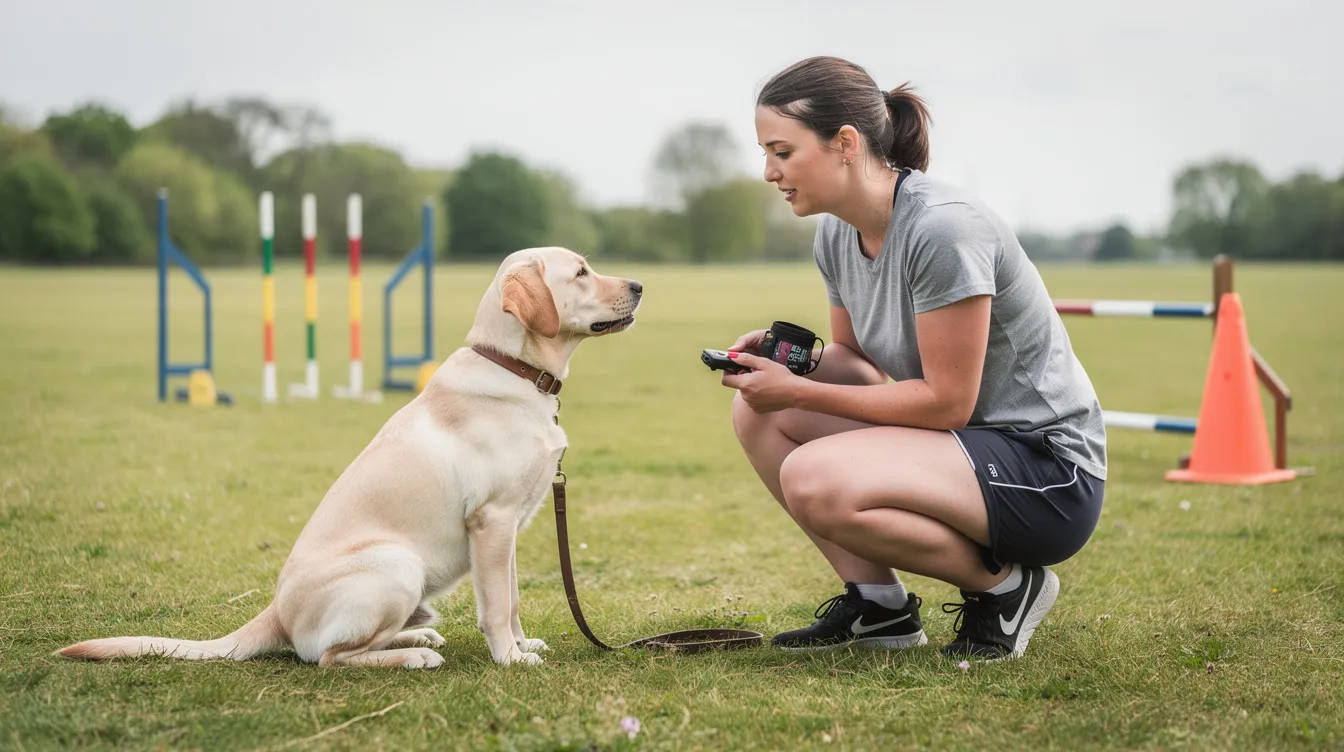
Psychiatric service dog training has three core components: basic obedience, public access skills, and disability-specific task training.
Basic obedience training. This covers sit, down, stay, recall, loose-leash walking, ignoring food and other animals, and remaining calm in noisy or crowded places like buses, malls, and medical offices. Basic obedience training for service dogs takes 3 to 6 months, and it forms the essential foundation for everything else.
Task training. This is the specialized training that separates a PSD from a pet. Examples include teaching the dog to interrupt panic attacks with paw nudges, provide deep pressure therapy on cue, lead the handler outside during overwhelming anxiety, offer balance support on stairs when medications cause dizziness, or interrupt repetitive behaviors. A service dog trained for PTSD might also learn to wake a handler from night terrors or perform room checks. The dog’s behavior must be reliable across different environments – not just at home.
Training options and timelines. Dog training can happen through owner training with books and online courses, in-person classes with a professional trainer familiar with PSD work, or board-and-train programs. Quality and cost vary widely. Training a psychiatric service dog typically takes 6 to 24 months depending on the dog’s temperament, the complexity of tasks, and the training method used. Extensive training and ongoing refresher work are normal – this is not a one-and-done process.
Many owner-trainers use a “public access test” checklist modeled on common industry standards to evaluate readiness, even though there is no official federal test required.
Costs, Time Commitment, and Whether a Psychiatric Service Dog Is Right for You
PSDs can be life-changing, but they are not appropriate or necessary for everyone with a mental health condition.
Costs in perspective:
|
Training Path |
Estimated Cost |
|---|---|
|
Pre-trained PSD from an organization |
$15,000–$30,000 |
|
Professional training for your own dog |
$3,000–$10,000 |
|
Owner-training (materials, classes, gear) |
$1,000–$3,000 |
|
Ongoing annual expenses (vet, food, gear) |
$2,000–$5,000 |
Professional training for a psychiatric service dog costs $3,000 to $10,000, while pre-trained psychiatric service dogs cost between $15,000 and $30,000. Ongoing expenses for a psychiatric service dog average $2,000 to $5,000 annually for veterinary care, food, grooming, and equipment.
Daily responsibilities include feeding, grooming, regular veterinary care, ongoing training, and ensuring the dog gets adequate physical and mental exercise. Even during periods of severe symptoms, the dog needs consistent care.
Before committing, ask yourself honestly: Can you safely care for a dog during your worst episodes? Does a PSD add something essential beyond what emotional support, therapy, medication, and coping skills already provide? Are you prepared for the time, cost, and energy?
Discuss the idea with your treatment team. A PSD should fit into a comprehensive mental health care plan rather than serve as a stand-alone cure.
Emotional Support Animals vs. Psychiatric Service Dogs: Which Might Fit Your Needs?
Some people benefit more from a lower-responsibility emotional support animal at home, while others need the intensive assistance and public access rights of a PSD.
When an ESA might be enough: Milder anxiety or depression that does not severely limit daily living, where companionship and routine are the main benefits and you rarely need task-based help in public. Emotional support dogs can provide genuine comfort and structure without the extensive training commitment.
When a PSD may be more appropriate: Frequent panic attacks in public places, severe PTSD with night terrors and flashbacks, or bipolar disorder where specifically trained tasks significantly reduce risk and improve independence. If you need a dog that can perform tasks in grocery stores, on buses, or in your workplace, you need a service animal – not an ESA.
Under the Fair Housing Act, both ESAs and PSDs may be eligible for housing accommodations. But only PSDs have broad public access rights under the ADA. If public access is important to your daily life, an ESA will not meet that need.
Whichever option you choose, ongoing mental health care and crisis plans remain critical. Neither a PSD nor an ESA replaces professional treatment for mental health issues or mental health disorders.
Disclaimer
This article is for general information and education only. It does not constitute legal advice and does not replace individualized guidance from a licensed attorney, veterinarian, or licensed mental health professional. Laws and regulations may change. For questions about your specific situation, including safety concerns, consult qualified professionals.
Frequently Asked Questions
Do I need a letter from a doctor or therapist to have a psychiatric service dog?
The ADA does not require a letter or documentation for public access. However, housing providers under the Fair Housing Act and airlines under the Air Carrier Access Act may ask for supporting information about your disability and need for a PSD. Having documentation from your clinician is practical, even if not always legally required.
Can I train my own dog to be a psychiatric service dog?
Yes. U.S. federal law allows handlers to train their own dogs as psychiatric service dogs. There is no requirement to use a professional organization or certified trainer. The dog must be reliably task-trained and behave appropriately in public. Owner-training a psychiatric service dog typically takes 18 to 24 months and demands consistent effort.
Are there age or breed requirements for psychiatric service dogs?
The ADA does not specify breed restrictions for service animals, and local breed bans cannot be applied to legitimate service dogs. In practice, dogs should be mature enough - often at least 12 to 18 months - and temperamentally suited to their tasks. Larger, sturdy breeds are preferred for balance support and tasks requiring body weight, while smaller breeds can excel at alerting and grounding tasks. Destructive behavior or reactivity typically disqualifies a dog regardless of breed.
What happens if my psychiatric service dog misbehaves in public?
Businesses are allowed to ask you to remove a PSD that is out of control, not housebroken, or poses a direct threat, even if it is a legitimate service animal. They must still offer you service without the dog. Consistent training and proactive management of the dog's behavior are essential to maintaining access rights.
Can my landlord charge pet rent or a pet deposit for my psychiatric service dog?
Under the Fair Housing Act, housing providers generally cannot charge pet fees or pet rent for PSDs. They can hold tenants financially responsible for actual damage caused by the dog. If a landlord denies reasonable accommodations for a legitimate PSD, this may constitute housing discrimination under federal law.
References
- U.S. Department of Justice, Civil Rights Division. "ADA Requirements: Service Animals." ADA.gov, revised 2020. (28 C.F.R. §35.104, §36.104, §35.136, §36.302.)
- U.S. Department of Housing and Urban Development. "Assessing a Person's Request to Have an Animal as a Reasonable Accommodation Under the Fair Housing Act." Notice FHEO-2020-01, Jan. 28, 2020.
- U.S. Department of Transportation. "Traveling by Air with Service Animals." 14 C.F.R. Part 382, final rule effective Jan. 11, 2021.
- Leighton SC, Rodriguez KE, Jensen CL, MacLean EL, O'Haire ME. "Service Dogs for Veterans and Military Members With PTSD: A Nonrandomized Controlled Trial." JAMA Network Open , June 4, 2024.
- Leighton SC, et al. "Psychiatric Service Dog Placements are Associated With Better Daily Psychosocial Functioning for Military Veterans With PTSD." Psychiatry , 2023.
- Rodriguez KE, et al. "Defining the PTSD Service Dog Intervention." Frontiers in Psychology , 2020.
- Assistance Dogs International. "Public Access Test Guidelines and Minimum Training Standards for Assistance Dogs." ADI Standards and Ethics Documents, accessed 2024.
- American Psychiatric Association. Diagnostic and Statistical Manual of Mental Disorders , 5th ed., text rev. (DSM-5-TR). American Psychiatric Publishing; 2022.

Pet Slimmers Editorial Team
The Pet Slimmers editorial team writes practical, evidence-based guidance on companion animal weight management, drawing on the work of the ROYAL CANIN® Weight Management Clinic at the University of Liverpool.
This article is for general information only and is not a substitute for professional veterinary advice. Always consult your veterinary surgeon about the health of your pet.