Best Service Dog Breeds for Disability Assistance
Key Takeaways
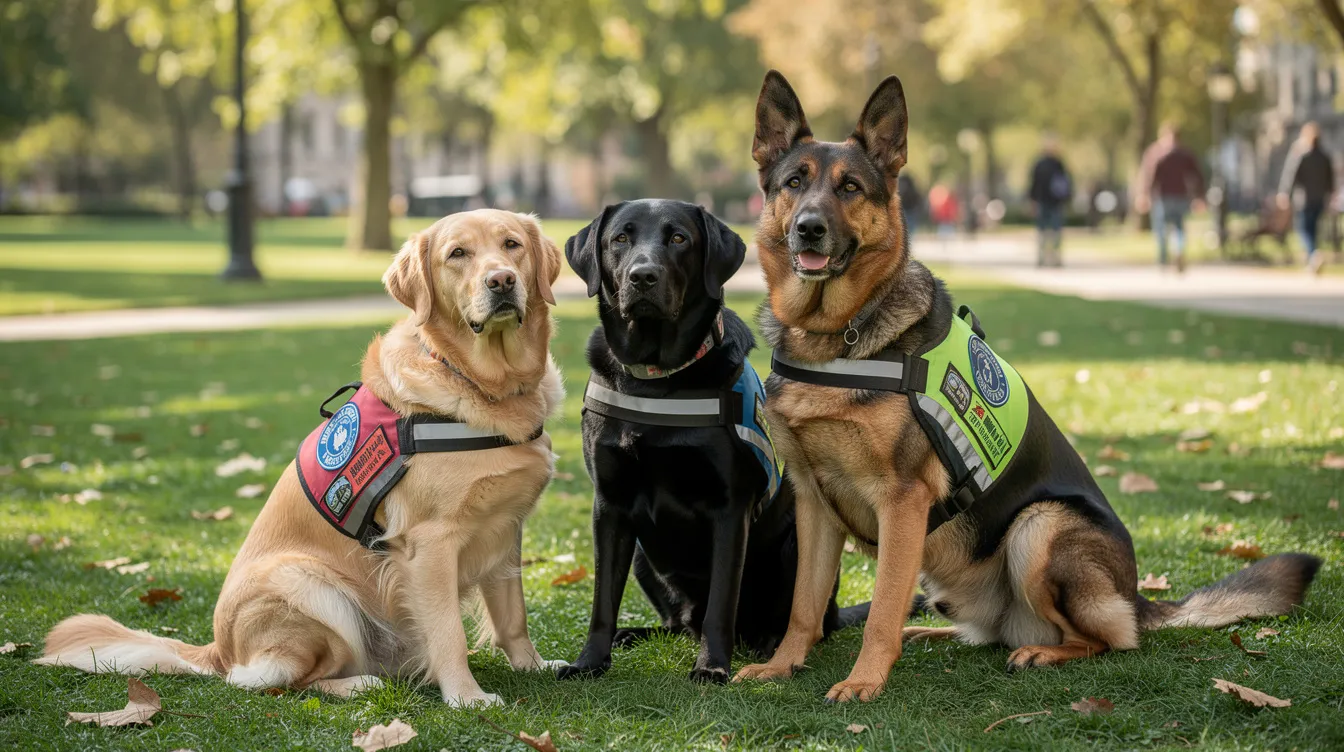
- Labrador Retriever, Golden Retriever, German Shepherd, and Standard Poodle are the top-performing service dog breeds, consistently placed by programs worldwide.
- These breeds excel due to their high intelligence, stable temperament, and eagerness to please-traits that translate directly into reliable disability assistance.
- But choosing the right service dog breed involves more than picking a popular name off a list.
- Common service dog tasks include guiding visually impaired individuals, medical alerts, mobility support, and psychiatric assistance, and not every breed handles each role equally well.
Introduction
Labrador Retriever, Golden Retriever, German Shepherd, and Standard Poodle are the top-performing service dog breeds, consistently placed by programs worldwide. These breeds excel due to their high intelligence, stable temperament, and eagerness to please-traits that translate directly into reliable disability assistance.
But choosing the right service dog breed involves more than picking a popular name off a list. Common service dog tasks include guiding visually impaired individuals, medical alerts, mobility support, and psychiatric assistance, and not every breed handles each role equally well. The ranking below draws on graduation rates from major training programs, peer-reviewed temperament research, and practical health data to help you make a grounded decision.
One critical caveat before diving in: individual temperament matters more than breed alone. A calm, focused Labrador from a poor breeding line may wash out, while a well-bred mixed breed with the right temperament can thrive. Breed narrows the odds-it doesn’t guarantee outcomes.
How We Chose the Best Service Dog Breeds
Selecting the best service dog breeds requires looking at measurable, practical criteria-not just reputation. Here’s what the research and professional programs prioritize:
-
Temperament stability and handler focus. A stable temperament is crucial for service dogs. Successful service dogs generally share a stable temperament and strong focus on their handler. Service dogs should be attentive to their handlers’ needs and must not be easily distracted by crowds, other dogs, or other animals in public spaces.
-
Trainability. High trainability is essential for service dogs because it allows dogs to quickly learn complex task sequences. Service dog breeds must be easy to train across a variety of specific tasks, from retrieving objects to detecting allergens.
-
Low reactivity. Service dog breeds must exhibit low reactivity and aggression to qualify. Calmness and responsiveness are essential traits-service dogs must be calm under pressure, whether navigating a busy airport or responding to a medical emergency.
-
Physical suitability. Different disability needs require different body types. A dog that performs bracing work for someone who is mobility impaired needs size and skeletal soundness. Alert work demands sensitivity, not strength.
-
Public access reliability. Dogs must behave predictably around strangers, loud noises, and unfamiliar environments. This behavioral consistency separates a good service dog from a pet with some training.
-
Health and working lifespan. Hip and elbow dysplasia, cancer, and cardiac issues can force early retirement. Purpose-bred dogs with health clearances offer longer, more reliable working careers.
One important legal note: the ADA does not restrict service dogs to particular breeds. Any breed or mixed breed may legally serve as a service animal, and no entity can exclude a properly trained service dog based on breed, size, or weight.
Top 7 Service Dog Breeds for Disability Assistance
1. Labrador Retriever
Labrador Retrievers are the most popular service dog breed, making up roughly 35% of working service dogs across programs globally. Their dominance isn’t accidental-it’s earned through decades of consistent performance.
Why It Stands Out: Labs offer exceptional emotional stability and clear handler communication. Their food motivation makes them highly responsive during service dog training, and their noise tolerance keeps them steady in unpredictable environments.
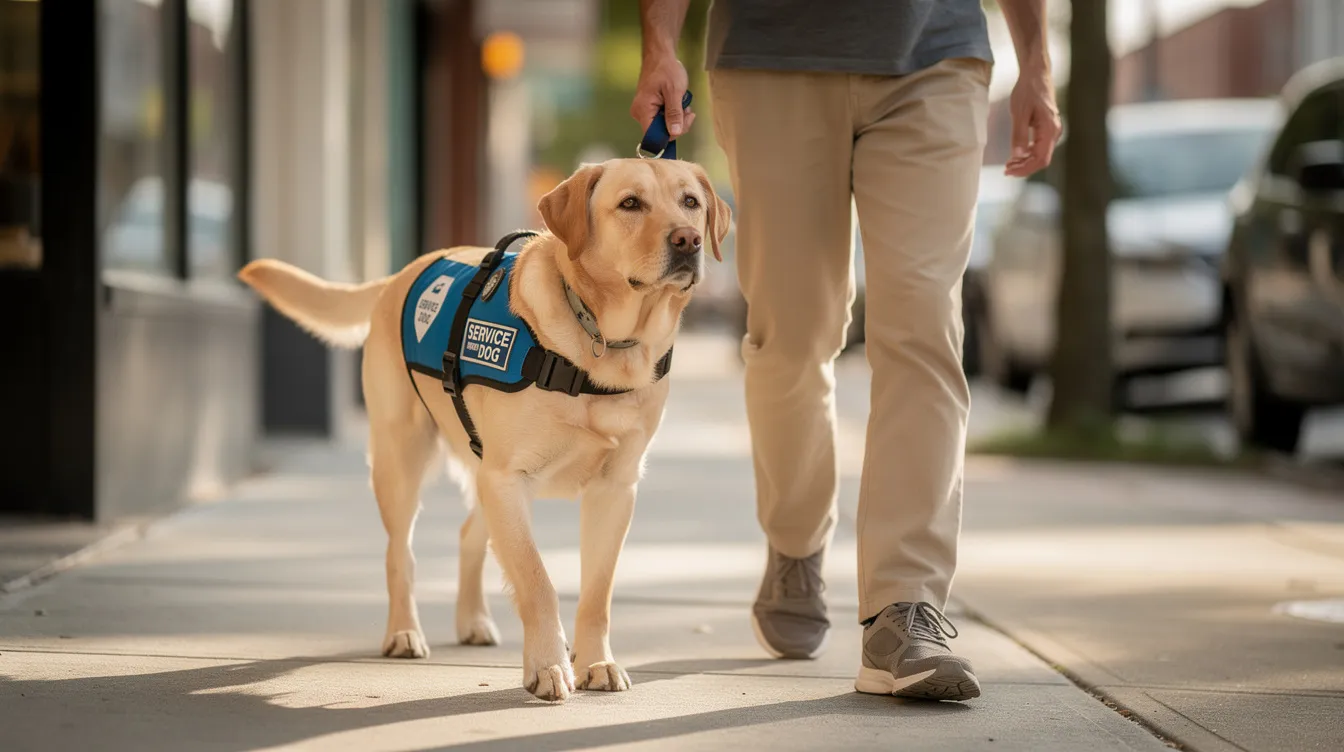
Best For: Guide dogs for the visually impaired, mobility assistance, and diabetic alert tasks. Service dogs can guide visually impaired individuals reliably, and Labs are the breed most programs turn to for this work.
Key Strengths:
-
Strong food drive accelerates training
-
Tolerant of loud noises and crowded spaces
-
Consistent, predictable temperament across well-bred lines
-
Graduation rates of approximately 60–70% in breed-focused programs
Possible Limitations: Labs require significant daily exercise. Without it, excess energy can undermine focus. They also shed heavily, which can be a concern for handlers sensitive to allergic reactions from dander.
2. Golden Retriever
Golden Retrievers bring something Labs sometimes lack: an almost intuitive sensitivity to their handler’s emotional state. This makes them standout candidates for psychiatric support roles.
Why It Stands Out: Golden Retrievers excel in emotional support and task reliability. Their people-oriented nature and gentle demeanor allow them to detect subtle shifts in a handler’s mood or stress levels.
Best For: PTSD support, autism assistance work, and roles where emotional attunement is the priority. Service dogs can assist with psychiatric conditions like PTSD, and Goldens are among the most effective breeds for this assistance work.
Key Strengths:
-
Superior empathy and emotional sensitivity
-
Gentle temperament well suited for work around children and families
-
Graduation rates of approximately 50–60% in major programs
-
Loving nature that builds strong handler bonds
Possible Limitations: Golden Retrievers carry a higher cancer risk than most breeds, which can shorten their working lifespan. Their heavy coat demands regular grooming, and some lines show lower confidence if socialization is delayed in the young dog phase.
3. German Shepherd Dog
German Shepherds were the first guide dogs, with their service work dating back to the 1920s when they were trained to assist veterans blinded in World War I. That working heritage runs deep.
Why It Stands Out: The German Shepherd Dog offers intense handler focus and high working memory. German Shepherds are extremely loyal, forming deep bonds with a single handler-an asset when the dog needs to anticipate needs without prompting.
Best For: Mobility work and physical support, psychiatric assistance requiring a strong handler bond, and single-handler situations where the dog serves one family member exclusively.
Key Strengths:
-
Among the smartest dog breeds, with versatile task performance
-
Highly intelligent and capable of learning complex command sequences
-
Strong enough for bracing and balance work
-
Average working lifespan of 10–11 years
Possible Limitations: German Shepherds require extensive socialization, especially during puppyhood. Without it, they can be reactive to novelty-new environments, unfamiliar people, or unexpected situations. They also carry higher rates of hip and elbow dysplasia and degenerative myelopathy compared to retrievers.
4. Standard Poodle
The Standard Poodle is often underestimated because of its grooming-heavy appearance, but this breed ranks among the most trainable breeds in any working category.
Why It Stands Out: Standard Poodles are hypoallergenic and highly trainable, making them the best option for handlers with allergies. Their non-shedding coat virtually eliminates the dander issues that sideline other breeds.
Best For: Alert work, detecting allergens for individuals with severe allergies, and detailed task training in allergy-sensitive households. Service dogs can detect allergens for individuals with allergies, and Poodles excel at this specialized service work.
Key Strengths:
-
Non-shedding, hypoallergenic coat
-
Quick learning with strong reasoning ability
-
Excellent for handlers who cannot tolerate other dog breeds due to allergic reactions
Possible Limitations: Grooming costs and time commitments are real-Standard Poodles require professional grooming every 4–6 weeks. Some lines can show over-arousal or noise sensitivity if breeding is neglected. Work with a reputable breeder who screens for temperament.
5. Labrador-Golden Cross
Many programs now breed dogs specifically by crossing Labs and Goldens-and the data supports this approach. In Seeing Eye studies, the Labrador-Golden cross achieved the highest guide dog graduation rate at approximately 59%, outperforming both purebred dogs from either parent breed.
Why It Stands Out: These crosses balance the Lab’s resilience with the Golden’s emotional sensitivity, often benefiting from hybrid vigor that reduces inherited health risks.
Best For: Guide work, versatile assistance tasks, and roles where balanced emotional stability matters.
Key Strengths:
-
Highest graduation rate among tested breed types in major guide dog programs
-
Genetic diversity may reduce risk of breed-specific disorders
-
Combines complementary strengths from two proven working dogs
Possible Limitations: Trait combinations can be unpredictable. Coat type, shedding level, and temperament may vary more than with purebred dogs. Availability is limited to programs that maintain dedicated crossbreeding efforts.
6. Bernese Mountain Dog
Bernese Mountain Dogs provide strong physical support for mobility assistance, and their size makes them natural candidates for bracing and balance work. Among gentle giants used in service dog work, Bernese dogs offer a calm presence that few breeds match.
Why It Stands Out: Their calm temperament and large frame make them ideal for handlers who need a dog they can physically lean on. Their low reactivity means they rarely startle or overreact.
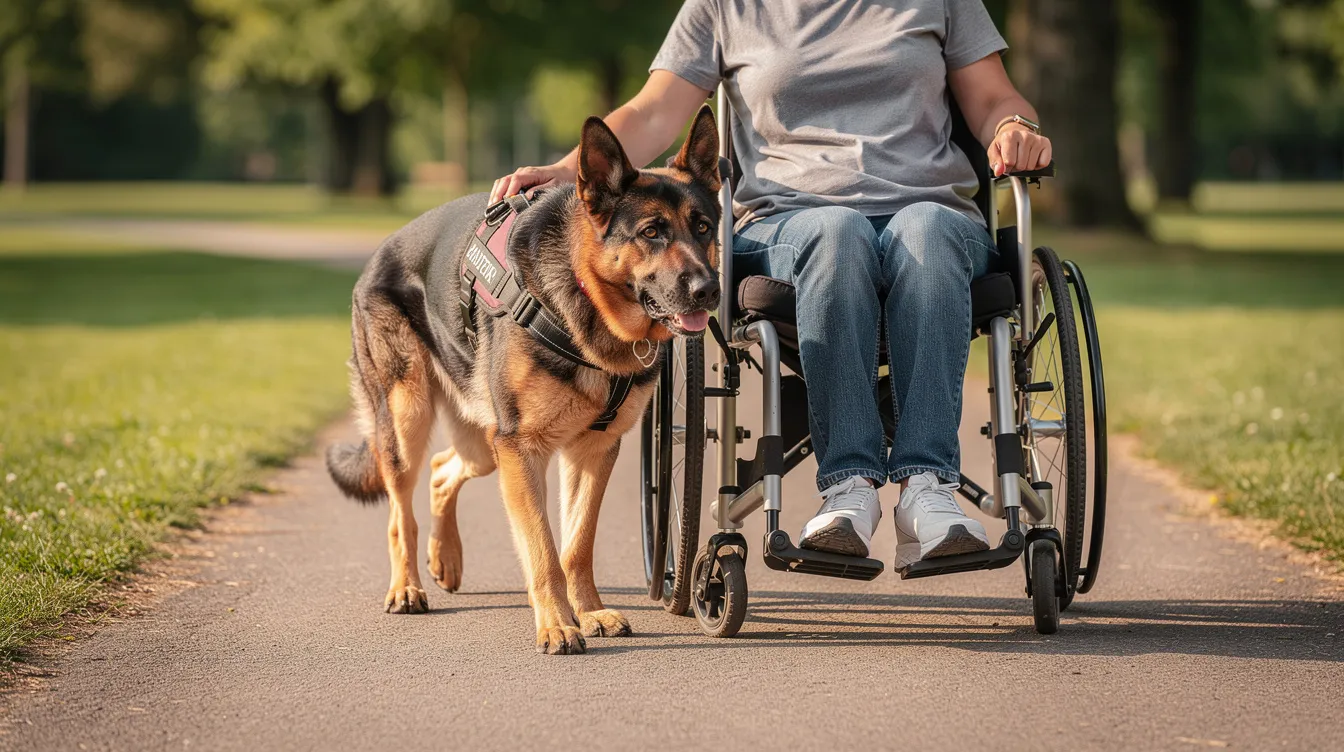
Best For: Mobility assistance, balance support, and wheelchair assistance for individuals with mobility issues. Great Danes can also assist with mobility due to their size and strength, but Bernese dogs tend to offer a more manageable temperament for most handlers.
Key Strengths:
-
Large enough for bracing and stability tasks
-
Naturally gentle demeanor
-
Low reactivity around strangers and other animals
Possible Limitations: Giant breed dogs have shorter working careers-often under 8 years-due to reduced life expectancy and higher orthopedic disease risk. They are not well suited for alert tasks or work requiring agility and speed.
7. Collie/Border Collie
Collies and Border Collies bring a different kind of intelligence to service dog work-pattern recognition and extreme sensitivity to subtle handler changes.
Why It Stands Out: These herding breeds can detect minute behavioral shifts, making them exceptional at seizure alert and medical detection work. Service dogs can alert individuals to medical problems, and Collies’ sensitivity gives them a natural advantage.
Best For: Seizure alert, medical detection, and roles where the dog must independently identify and respond to handler changes.
Key Strengths:
-
High working memory and vocabulary learning capacity
-
Sensitivity to handler’s physical and behavioral cues
-
Highly intelligent and eager to engage in mentally demanding tasks
Possible Limitations: Border Collies can experience over-arousal in busy environments. Their high prey drive and intense mental stimulation needs make them challenging for first-time handlers. They’re also smaller and unsuitable for physical-assist tasks like bracing. Experienced trainers are essential when working with these breeds.
Quick Comparison of the Best Service Dog Breeds
|
Breed |
Best For |
Size |
Coat Maintenance |
Typical Working Lifespan |
|---|---|---|---|---|
|
Labrador Retriever |
Overall reliability, guide work |
Large |
Moderate (sheds) |
8–10 years |
|
Golden Retriever |
Emotional support, psychiatric work |
Large |
High (long coat) |
7–10 years |
|
German Shepherd |
Handler-focused mobility assistance |
Large |
Moderate |
10–11 years |
|
Standard Poodle |
Allergy-sensitive handlers |
Medium-Large |
High (professional grooming) |
10–12 years |
|
Lab-Golden Cross |
Balanced program-bred reliability |
Large |
Moderate-High |
8–10 years |
|
Bernese Mountain Dog |
Physical bracing and support |
Giant |
High |
6–8 years |
|
Border Collie |
Medical alert and detection |
Medium |
Moderate |
10–12 years |
Great Danes provide physical support for mobility-impaired individuals and deserve mention as an alternative giant breed for handlers who need substantial bracing support, though they share the shorter lifespan common to giant breeds.
How Do You Choose the Right Service Dog Breed?
Picking the right service dog starts with honest self-assessment, not breed popularity. Here are the important factors to weigh.
Choose Based on Your Specific Disability Needs
Individuals should consider specific tasks when selecting a service dog breed. The match between task and dog determines everything:
-
Mobility support and bracing requires large, structurally sound breeds (Labs, Bernese, Great Danes)
-
Medical alert and detection favors sensitive, observant breeds (Collies, Poodles)
-
Psychiatric support benefits from emotionally attuned breeds (Goldens, Labs)
-
Guide work for the visually impaired demands steady, confident breeds (Labs, Lab-Golden crosses)
Service dogs can retrieve objects for individuals with mobility impairments, and this task alone requires a dog large enough and motivated enough to carry items reliably. Small breeds are effective for hearing alerts or psychiatric assistance tasks but cannot perform bracing or heavy retrieval work. Hearing dogs, for instance, can be smaller breeds like Cocker Spaniels trained to alert hearing impaired handlers to sounds.
Choose Based on Your Living Situation
Space, grooming capacity, and activity level matter. A Standard Poodle may solve your allergy problem but demands regular grooming appointments. A Labrador in a small apartment needs a plan for daily exercise. An American Staffordshire Terrier might have the right temperament individually, but breed characteristics should align with your local housing policies and lifestyle.
Choose Based on Handler Experience
Not all dogs are equally forgiving of handler mistakes. If you’re owner trained, Labs and Goldens offer the most forgiving learning curve. German Shepherds and Border Collies demand more experience, more socialization time, and more structured extensive training from day one. A rescue dog may have the right temperament but requires careful evaluation-consider working with experienced trainers or an ADI-accredited program.
Which Service Dog Breed Is Best for You?
There’s no single perfect dog for every handler. Here’s a practical decision framework:
-
Choose a Labrador Retriever if you need proven reliability across multiple task types and want the breed with the highest overall placement rates
-
Choose a Golden Retriever if emotional attunement and psychiatric support are your primary needs
-
Choose a German Shepherd if you want intense handler focus and are prepared for the socialization commitment
-
Choose a Standard Poodle if allergies rule out shedding breeds
-
Choose a Lab-Golden Cross if you’re working with a program that breeds them specifically
Mixed-breed dogs can also be effective service dogs, but success rates vary. However you narrow your options, work with professional evaluators for individual assessment. Breed tells you the odds-temperament testing tells you the dog. Consider your own needs, living situation, and the specific tasks you require before committing to any breed.
Final Thoughts
The right dog for service work is defined by temperament, health, and training-not by breed papers alone. Among the most popular breeds, Labs, Goldens, German Shepherds, and Standard Poodles consistently produce excellent service dogs for the same reasons: they’re calm, focused, and properly trained candidates thrive in demanding public environments.
But breed narrows odds without guaranteeing success. Approximately 30–70% of dogs entered into training programs never graduate, regardless of breed. Professional evaluation, health screening from a reputable breeder, and structured service dog training remain the strongest predictors of a successful working partnership.
Note that emotional support animals and therapy dogs are not the same as service dogs under the ADA. A service animal must perform tasks directly related to a disability-simply providing comfort does not qualify.
Disclaimer
This article provides general information about service dog breeds and is not legal advice. ADA requirements are federal, but some aspects of service animal law vary by state. Consult a qualified attorney for specific legal questions and work with accredited training programs or experienced trainers for individual dog evaluations.
Frequently Asked Questions
What is the most popular service dog breed?
Labrador Retrievers are the most popular service dog breed, representing roughly 35% of working service dogs across major placement programs. Golden Retrievers follow at approximately 28%, with German Shepherds at around 12%. Labs dominate for the same reasons they top this list: consistent temperament, high trainability, and versatility across task types.
Can any dog breed become a service dog?
The ADA places no breed restrictions on service dogs. Legally, any breed-including an American Staffordshire Terrier or a Cocker Spaniel-can serve. However, practical success depends on the individual dog's temperament, trainability, and task suitability. Not all dogs have the right temperament for this demanding work.
Are small dogs suitable as service dogs?
Small breeds can be highly effective for hearing alerts, psychiatric assistance, or detecting allergens. They cannot, however, perform mobility or bracing work. The right dog depends entirely on the handler's specific tasks and own needs.
Do service dogs need to be purebred?
No. Mixed breed dogs can be effective service dogs, and Lab-Golden crosses are among the most successful working dogs in guide dog programs. Individual temperament assessment matters more than pedigree, though purebred dogs from established lines offer more predictable breed characteristics.
How long does it take to train a service dog?
Professional service dog training typically takes 18–24 months. Owner-trained service dogs generally require 1–2 years of consistent daily work. Training timelines vary by task complexity-a puppy destined for guide work may need longer than one trained for hearing alerts.
Do I need to register my service dog?
No. The ADA does not require any registration, certification, or ID cards for service dogs. These products are optional and carry no legal weight. Businesses may only ask two questions: whether the dog is required because of a disability, and what specific tasks the dog has been trained to perform. They cannot demand documentation.
References
- Americans with Disabilities Act, Title III Regulations, § 36.302 - Service animal definitions, breed restriction prohibitions, and public accommodation rules. U.S. Department of Justice.
- ADA.gov, "Frequently Asked Questions about Service Animals and the ADA" - Definitions, qualifying tasks, legal status of registration and certification. U.S. Department of Justice.
- Assistance Dogs International (ADI), Summary of Standards, 2026 - Health, breeding, behavior, training standards, and public access requirements for accredited programs.
- Ennik, I., et al. "Suitability for Field Service in 4 Breeds of Guide Dogs." Journal of Veterinary Behavior , 2006 - Comparative graduation rates for Labrador Retrievers, Golden Retrievers, German Shepherds, and Labrador × Golden crosses.
- Serpell, J.A. & Hsu, Y. "Selecting Quality Service Dogs: Part 1: Morphological and Health Considerations." Frontiers in Veterinary Science , 2015 - Breed health risks, morphological traits, and orthopedic screening for service dog candidates.
- Bray, E.E., et al. "Early-emerging and highly heritable sensitivity to human communication in dogs." Current Biology , 2021 - Behavioral predictors of service dog success including fear/reactivity at 6 and 12 months.
- Frontiers in Veterinary Science, 2026 - Breed effects on assistance dog career outcomes across multiple organizations.

Pet Slimmers Editorial Team
The Pet Slimmers editorial team writes practical, evidence-based guidance on companion animal weight management, drawing on the work of the ROYAL CANIN® Weight Management Clinic at the University of Liverpool.
This article is for general information only and is not a substitute for professional veterinary advice. Always consult your veterinary surgeon about the health of your pet.