How To Prove Your Dog Is a Service Dog (Without Illegal “Papers”)
Key Takeaways
- Under U.S. federal law, there is no official service dog certification, registration, or special identification card required. The ADA governs public access for service dogs in the United States, and proof in everyday settings comes down to answering two permitted questions and showing your dog's trained behavior.
- Businesses, state and local governments, and nonprofits generally cannot require certification, vests, or ID cards to prove an animal is a service dog under the Americans with Disabilities Act.
- Different rules apply in different settings. Airlines can request specific forms under the Air Carrier Access Act (ACAA), and housing providers may ask for documentation under the Fair Housing Act (FHA), so the proof you need depends on where you are.
- Many states penalize falsely claiming a pet is a service animal. Handlers should only represent a dog as a service animal when it is individually trained to perform tasks directly related to the person's disability.
- This article provides practical, U.S.-focused guidance only. It is not legal advice. See the full disclaimer below.
In the United States, there is no federal “service dog license,” no government-issued certification, and no national registry that makes a dog officially a service animal. Proof that your dog is a service dog comes down to answering two specific questions permitted under the Americans with Disabilities Act (ADA) and demonstrating your dog’s trained behavior in real-world settings. This guide walks through exactly what counts as proof in stores, restaurants, airlines, housing, workplaces, and schools so you can protect your rights without relying on illegitimate paperwork.
What counts as a service dog under U.S. law?
Under the ADA’s 2010 revised regulations, a service animal is defined as a dog that is individually trained to do work or perform tasks for a person with a disability. In limited cases, miniature horses may also qualify, but the ADA recognizes only dogs as service animals for public-access purposes. Service dogs are trained to perform tasks related to disabilities, and the task must be directly related to the handler’s disability.
Here is how to distinguish service dogs from other animals:
-
Service dogs – trained to perform specific tasks tied to a person’s disability. This is the only category that qualifies under the ADA.
-
Emotional support animals – provide comfort through their presence alone. The ADA does not recognize emotional support animals as service animals.
-
Therapy dogs – used in clinical or therapeutic settings under supervision. Not covered by ADA public-access rules.
-
Pets – no disability-related task training and no legal protection under the ADA.
Concrete task examples include:
-
Guiding a blind handler through obstacles
-
Service dogs can detect seizures for individuals with epilepsy
-
Service dogs can alert individuals with PTSD to panic attacks
-
Service dogs can remind individuals with depression to take medication
-
Service dogs can retrieve objects for wheelchair users
-
Alerting to dangerous blood sugar changes for diabetic handlers
The definition of a service dog under the ADA is separate from how other animals are defined under the Air Carrier Access Act (airlines) and the Fair Housing Act (housing). Those differences are covered in the sections below.
How do you “prove” your dog is a service dog in everyday public places?
In ADA-covered settings, which include most businesses, state and local governments, and nonprofits, proof is based on only limited inquiries and observable behavior. Documentation for service dogs is not legally required under ADA. There are no papers to present, no registration to show, and no certification to carry.
Staff may only ask specific questions to determine if a dog is a service animal. When it is not obvious that an animal is a service animal, staff are permitted to ask only two questions:
-
“Is the dog a service animal required because of a disability?”
-
“What work or task has the dog been trained to perform?”
That’s it. Only two questions can be asked about service animals. Here is what staff cannot do:
-
Request details about the person’s disability
-
Demand medical documentation or records
-
Require a special identification card, certification, or registration
-
Ask the dog to demonstrate its task on the spot
Handlers do not need to disclose their disability to prove their dog is a service animal. A succinct response works best. For example: “He alerts me before I have a seizure” or “She helps me with balance when I walk.” These answers work for both visible and invisible disabilities.
Service animals are allowed in public spaces where pets may be prohibited. The most convincing proof that an animal is a service dog is its behavior. A dog that remains calm, stays under control, and performs its task reliably in public demonstrates its role far more effectively than any piece of paper. If an animal exhibits disruptive behavior, the business may ask the handler to remove the dog, regardless of claimed status.
Do you need certification, registration, or an ID card to prove a service dog?
Under the Americans with Disabilities Act, there is no legal requirement for service dog certification. There is no federally recognized U.S. service dog certification, national registry, or mandatory ID system. Service animals are not required to wear vests or ID to be granted access.
Key points to understand:
-
Online “registries,” certificates, and ID badges sold by private companies generally have no legal status under federal law. Purchasing online certificates does not grant legal rights regarding service dogs. Local businesses and government entities cannot demand them as a condition of entry.
-
Some state or local governments operate voluntary service animal registration or tagging programs, for example to alert first responders or reduce licensing fees. However, participation in these programs cannot be mandatory for ADA access.
-
The U.S. Department of Justice and organizations like Assistance Dogs International have warned about fraudulent websites that sell “official” service dog papers. These sites mislead handlers and can encourage service animal fraud.
-
While voluntary IDs, vests, or harness labels may make public interactions smoother and reduce unnecessary questions, they are optional tools. They do not replace the legal standard of task training and disability-related need.
Customers cannot be asked for proof of certification or registration for a service dog. No vest, no card, and no other id creates legal service-dog status on its own.
How do you prove your dog is a service animal to airlines?
Air travel is governed by the U.S. Department of Transportation under the Air Carrier Access Act, not the ADA. Different rules apply than in ordinary public-access settings, and airlines can request more documentation than a retail store or restaurant.
Airlines generally recognize only dogs as service animals under current DOT rules. The dog must be individually trained to perform tasks for a qualified individual with a disability. Emotional support animals and comfort animals usually travel as pets under current regulations.
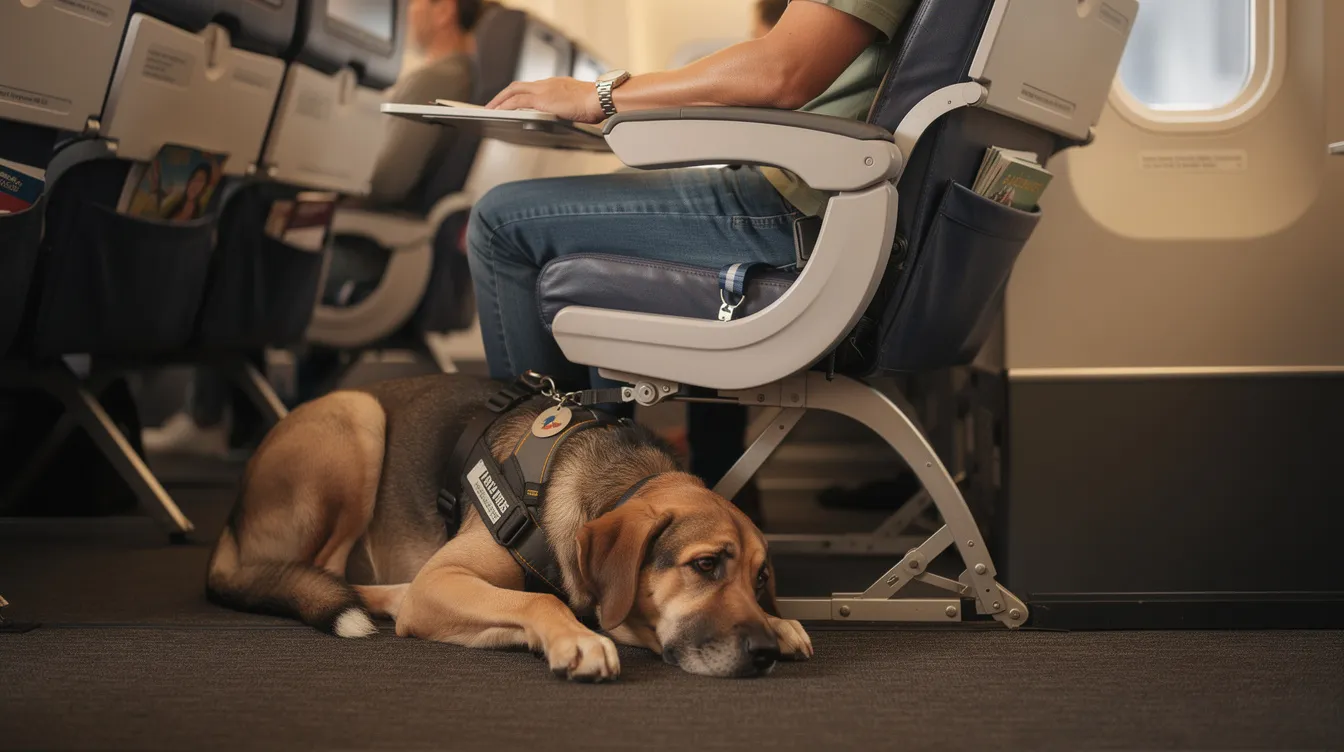
Airlines may require a DOT Service Animal Air Transportation Form. Many carriers ask that this form be completed and submitted at least 48 hours before departure. The form covers the animal’s health, training documentation, and behavior attestation.
What to expect when flying:
-
Completion of the DOT Service Animal Air Transportation Form
-
Confirmation the dog can fit in the handler’s foot space without blocking aisles
-
Assurance the dog will remain under control throughout the flight
-
For flights of 8 hours or more, a separate DOT Service Animal Relief Attestation Form may be required
-
Airlines can deny boarding if safety or behavior standards are not met
Service dogs can fly in the cabin at no charge. Businesses cannot charge fees for service animals, and this extends to airlines under the ACAA.
For international flights, regulations of the destination country, quarantine or vaccination rules, and airline-specific policies all come into play. Check both the airline and the country’s requirements well before your departure date.
How do you prove your dog is a service animal in housing situations?
Housing is regulated primarily under the Fair Housing Act and U.S. Department of Housing and Urban Development guidance. These laws use broader terms like assistance animal, which can include both service dogs and, in some cases, emotional support animals.
Under the FHA, both service dogs and certain other assistance animals may be allowed in “no pets” housing as a reasonable accommodation for a disability. This differs from strict ADA service animal rules, which cover only dogs trained to perform specific tasks.
Common proof requirements in housing:
-
A written reasonable accommodation request to the landlord or property manager
-
If the disability and need are not obvious, a letter from a licensed health-care provider verifying the person’s disability and the disability-related need for an animal, without requiring a detailed diagnosis
-
The letter should confirm that the animal’s presence alleviates one or more effects of the disability
Landlords generally cannot require medical documentation beyond what is needed to establish that the person has a disability and that the animal helps. They also cannot demand specific training certificates or training documentation, and they cannot charge pet fees for an assistance animal.
Housing rules vary by state and by type of property. Subsidized housing, senior housing, and different state laws can affect what documentation is needed. Readers should check current HUD guidance and consult a legal professional for complex cases.
How do you prove your service dog at work or in schools?
Employment and education settings each have their own rules. Workplaces fall under the ADA’s Title I, enforced by the EEOC. Schools, both K–12 and colleges, are often covered by ADA Titles II and III and Section 504 of the Rehabilitation Act. These rules can differ from public-access rules.
In workplaces, employees typically request a reasonable accommodation through their employer. If both the disability and the need for the animal are not obvious, the employer may ask for documentation from a health-care provider establishing the person with a disability needs the dog. However, employers typically still cannot demand service-dog certification or require training documentation. Employers may evaluate whether allowing a service dog is reasonable in light of job duties, safety requirements, and potential undue hardship. An interactive discussion between employer and employee is expected.
In schools, students with disabilities may have the right to be accompanied by a service dog. Schools may set reasonable rules about control, vaccinations, and where the dog can rest, but they must follow ADA and Section 504 obligations. Courts have held that even self-trained dogs are acceptable. In the case of C.L. v. Del Amo Hospital, the court ruled that imposing a certification requirement on a handler’s self-trained dog was unlawful under the ADA.
Families and employees should consult official EEOC and Department of Education guidance for detailed, situation-specific information.
What behavior and training help “prove” a dog really is a service animal?
While no certificate is required, the strongest practical proof that an animal is a service dog is its training, reliability, and public behavior over time. A service dog’s behavior typically demonstrates its role in assisting a person with a disability far better than any card or registration.
Key behavior indicators:
-
Staying calmly by the handler’s side
-
Ignoring distractions such as food, other animals, and crowds
-
Not soliciting attention from strangers
-
Not barking or lunging except when performing a trained alert
-
Remaining under control via leash, harness, or voice commands
Task reliability matters. A service dog consistently performs tasks related to the handler’s disability in real-world situations, whether that means alerting to medical events, providing balance support, or retrieving dropped items. This is what distinguishes a service dog from an untrained pet.
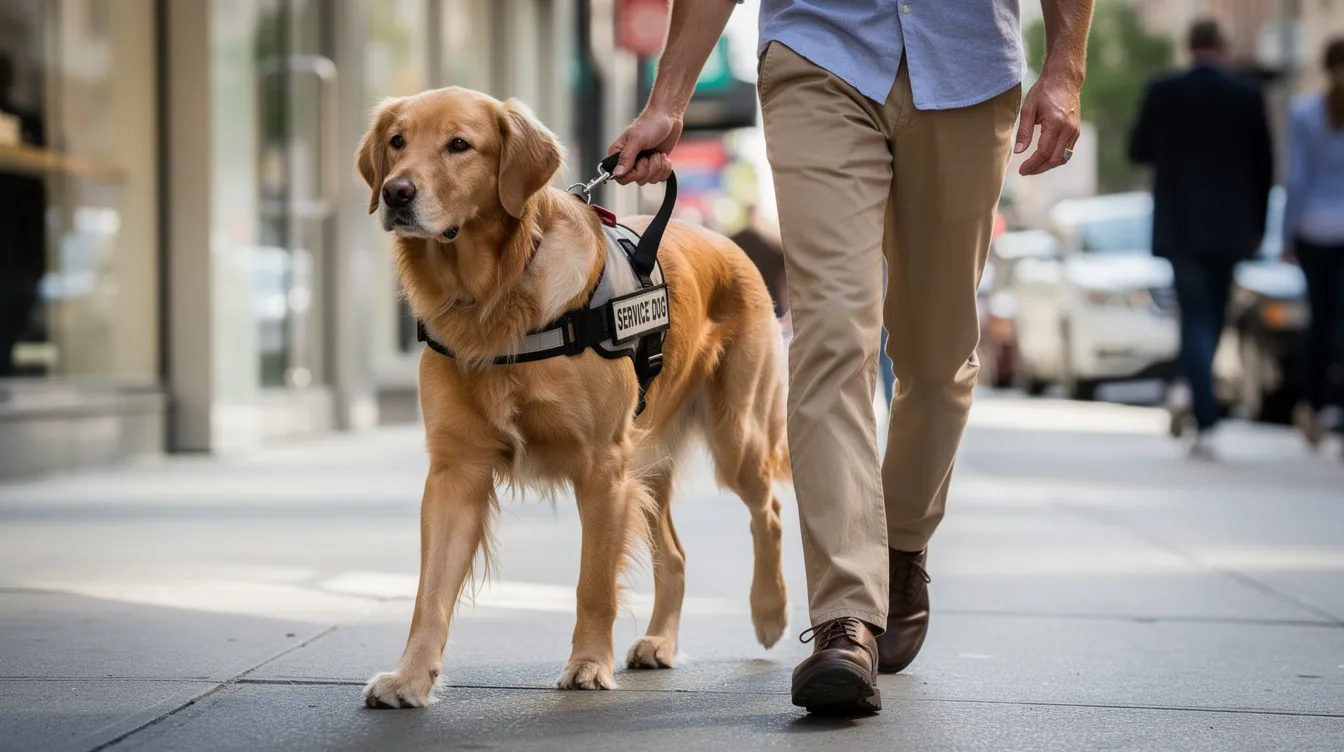
Service dogs can be trained by their owners as well as professionals. Under the ADA, both paths are acceptable as long as the dog is individually trained to assist with the person’s disability. There is no requirement to use a professional training program. Some handlers maintain training logs or work with reputable programs accredited by Assistance Dogs International, which can be useful in disputes even though not legally required.
Service dogs must behave properly in public during travel and in all other settings. A dog that cannot behave properly can be asked to leave, regardless of training history.
What can businesses and local governments legally ask about your service dog?
State and local governments, along with most businesses, are covered by the ADA. The same limited inquiries apply when they need to determine whether an animal is a service dog.
The two permissible ADA questions remain:
-
“Is the dog a service animal required because of a disability?”
-
“What task has the dog been trained to perform?”
These are permitted because they establish whether the dog meets the legal definition without invading the handler’s privacy. Staff are not allowed to go further.
What staff cannot ask or require:
-
Medical records or explanation of the person’s disability
-
A special identification card, certification, or registration
-
That the dog demonstrate its tasks
-
Extra fees, deposits, or surcharges solely because the handler has a service animal
-
Segregation of the handler to a separate area
When can a business ask a handler to remove a service dog? Only if the animal is out of control and the handler does not take effective action to regain control, or if the dog is not housebroken. Even then, the business must still offer goods and services to the handler without the animal present. A direct threat to the health or safety of others is also grounds for removal.
State and local governments can impose general licensing, vaccination, and leash laws that apply to all dogs, including service animals. But they cannot require service-dog-only registrations as a condition for access.
How can you document your service dog for your own protection?
Personal records and documentation are optional but can be helpful if questions or disputes arise about whether an animal is a service dog. Think of these as tools for convenience, not legal requirements.
Recommended optional documentation:
-
Veterinary records – Keep vaccinations and licensing current and accessible. Many state and local governments require these for all dogs, and businesses may legitimately ask about vaccination when it is part of general policy.
-
Task description – A brief written description of the dog’s tasks and the work or task the dog has been trained to perform.
-
Trainer information – Contact information for a trainer or program, if applicable.
-
Training logs – Notes on training sessions and task performance over time.
-
Medical professional letters – Especially useful for housing or employment accommodation requests.
Using a vest or harness label such as “Service Dog – Do Not Pet” is optional but often reduces unnecessary challenges. These items do not create legal service-dog status, but they help signal that the dog is working.
Avoid misrepresenting a pet as a service animal on any self-made or purchased cards. Many states now have fines or penalties for service animal fraud, and dishonest claims make life harder for every legitimate handler.
What are the penalties for misrepresenting a pet as a service animal?
Many U.S. states have enacted laws against falsely claiming that a pet is a service animal. As of 2022, 33 states have laws against service dog fraud. These laws are designed to protect people who rely on genuine service dogs from increased skepticism and access challenges.
Typical consequences include:
-
Fines ranging from $200 to several hundred dollars or more
-
Misdemeanor charges in many states
-
Community service, sometimes up to 100 hours (as in Tennessee under §39-16-304)
-
In West Virginia (§5-15-9), a first offense can carry fines up to $200 or up to 10 days in jail
Exact penalties and definitions differ by state and should be verified in local statutes.
Under the ADA itself, “service animal fraud” is not directly criminalized at the federal level. Instead, the ADA addresses the issue indirectly through behavior-based exclusions, allowing businesses to remove animals that are disruptive or not under control.
Fraudulent representations damage public trust, make access harder for legitimate handlers, and can pose safety risks to real service dogs when untrained pets cause incidents in public places.
If you are unsure whether your animal qualifies as a service dog, review ADA criteria carefully. Seek guidance from qualified trainers or disability-rights organizations rather than relying on online “instant certification” sites.
Disclaimer: general information, not legal advice
This article is for general educational purposes about service animals and service dogs in the United States, based on publicly available federal guidance as of mid-2026. It does not constitute legal advice.
Laws and regulations change. State, local, airline, housing, and employment policies can differ significantly. Readers should check current rules and consult an attorney or qualified advocate for advice about their specific situation.
Citing ADA.gov, U.S. DOT, HUD, EEOC, and other sources in this article does not create an attorney–client relationship or constitute individualized legal guidance.
Frequently Asked Questions
Can a business ask my service dog to perform its tasks as proof?
No. Under ADA guidance, staff may not require that a dog demonstrate its tasks. They are limited to the two questions and assessing the dog's behavior and control in the moment. If the animal is disruptive, the business may ask that the dog be removed, but that action is based on conduct, not failure to perform a "test." There is no happen-on-the-spot performance requirement.
Does my service dog have to wear a vest to be considered legitimate?
No federal law requires service dogs to wear vests, harness labels, or ID tags. Many handlers choose vests because they reduce questions and help signal that the dog is working, but the lack of a vest cannot legally be the sole reason to deny access in ADA-covered settings. Whether or not a dog wears any identifying gear, the legal standard remains task training and disability-related need.
Can hotels or vacation rentals ask for proof that my dog is a service animal?
Hotels open to the public are usually treated like other public accommodations under the ADA and must follow the two-question rule. They cannot demand documentation or charge pet fees for service dogs. However, long-term rentals, vacation homes, and certain other arrangements may fall under the Fair Housing Act, where housing-style disability documentation rules can apply. Confirm which law governs your stay before booking.
Can I train my own service dog, or do I need a professional program for proof?
The ADA allows owners to self-train their service dogs. There is no requirement to use a professionally trained program or a licensed trainer for the animal to qualify. What matters legally is that the dog is individually trained to perform specific tasks related to the handler's disability and can behave properly in public, regardless of who provided the training.
Do the same proof rules apply outside the United States?
This article is based on U.S. federal law. Other countries may require government-issued IDs, certified training, quarantines, or entirely different forms of proof for service animals. If you are traveling or relocating abroad, check the official government websites of the destination country and contact its consulate or embassy for current service-animal entry and documentation requirements.
References
- ADA.gov - "ADA Requirements: Service Animals" (revised 2010 regulations, updated guidance). U.S. Department of Justice.
- U.S. Department of Transportation - "Service Animals" (Air Carrier Access Act rules, 14 CFR Part 382).
- U.S. Department of Transportation - "DOT Service Animal Air Transportation Form" (last updated September 20, 2024).
- 14 CFR § 382.75 - Service Animal Relief Attestation requirements for flights of 8 hours or more.
- U.S. Department of Housing and Urban Development - "Assistance Animals" (Fair Housing Act guidance on reasonable accommodations).
- U.S. Equal Employment Opportunity Commission - "Enforcement Guidance: Reasonable Accommodation and Undue Hardship Under the ADA."
- Tennessee Code § 39-16-304 - Misrepresentation of service or support animals.
- West Virginia Code § 5-15-9 - False representation of a service animal.
- Assistance Dogs International - Standards for accredited service dog programs.
- C.L. v. Del Amo Hospital, U.S. Court of Appeals for the Ninth Circuit (2021) - Certification requirements for self-trained service dogs held unlawful.

Pet Slimmers Editorial Team
The Pet Slimmers editorial team writes practical, evidence-based guidance on companion animal weight management, drawing on the work of the ROYAL CANIN® Weight Management Clinic at the University of Liverpool.
This article is for general information only and is not a substitute for professional veterinary advice. Always consult your veterinary surgeon about the health of your pet.