How Many Calories Does My Dog Need a Day?
Medically reviewed by Dr. Alex German, BVSc PhD CertSAM DipECVIM-CA — Reader in Small Animal Medicine, University of Liverpool
Key Takeaways
- Most moderately active, neutered adult dogs need roughly 25–30 kcal per pound of ideal body weight per day . A 30 lb (13.6 kg) dog might need about 700–900 kcal daily; a 60 lb (27.3 kg) dog about 1,300–1,600 kcal. These are starting estimates that must be tailored to the individual dog.
- Veterinarians calculate a dog's daily energy requirement in two steps: first, the resting energy requirement (RER = 70 × [body weight in kg]^0.75), then multiply by a life stage and activity factor to get the maintenance energy requirement.
- Body condition score on a 1–9 scale is as important as the number on the scale. Owners should adjust daily calories every 2–4 weeks based on body condition, weight trend, and the dog's energy and coat quality.
- Treats, chews, and table scraps must be included in daily calories and should not exceed 10% of total daily calories to protect balanced daily food nutrition.
- Any weight loss plan should be supervised by a veterinarian, aiming for around 1–2% body weight loss per week. The ROYAL CANIN Weight Management Clinic at the University of Liverpool uses these same evidence-based methods for every patient.
Most healthy, neutered adult dogs need roughly 25–30 calories per pound (55–65 kcal/kg) of ideal body weight per day. That said, this is only a starting estimate. Your dog’s actual caloric needs depend on age, breed, activity level, neuter status, and health, so ongoing adjustment is essential.
How many calories should my dog eat each day?
Many moderately active, neutered adult dogs at ideal body condition need around 25–30 kcal per pound of ideal body weight per day. In practice, that means a 30 lb (13.6 kg) dog might need roughly 750–900 kcal per day, a typical 50-pound dog needs about 1,165 calories daily, and a 60 lb (27.3 kg) dog might need about 1,300–1,600 kcal per day.
These ranges are starting estimates only. Individual caloric needs can vary by ±25% or more because of differences in metabolism, breed size, environment, and temperament. Two dogs of the same weight and lifestyle may still need different daily calories. That is why ongoing adjustment, not a single perfect number, is the real goal.
Throughout this article, you will see several key terms: daily energy requirement (DER), resting energy requirement (RER), maintenance energy requirement (MER), and references to a dog calorie calculator. Each helps translate your dog’s body weight into a practical feeding plan.
If your dog is overweight, their calorie intake should be based on ideal body weight and body condition, not their current weight. Any caloric restriction should be guided by a veterinarian to keep weight loss at a safe rate of about 1–2% of body weight per week. Determining a dog’s daily caloric intake depends on biological traits and lifestyle factors, so always cross-check with your own veterinary surgeon, because underlying health conditions can dramatically change caloric needs.
What are calories and daily energy requirements in dogs?
In pet nutrition, a “calorie” means a kilocalorie (kcal), the same unit printed on every dog food label. Calories measure how much usable energy a dog gets from fat, proteins, and carbohydrates in its diet.
Dogs need that energy for many reasons:
-
Breathing and heart function – even a sleeping dog burns significant calories keeping vital organs running.
-
Digestion and immune responses – breaking down food and fighting off illness both require energy.
-
Movement and thermoregulation – walking, playing, and maintaining body temperature all add to the daily total.
The resting energy requirement (RER) is the baseline number of calories a dog uses at rest in a thermoneutral environment, just for vital bodily functions. The daily energy requirement (also called the maintenance energy requirement) is RER multiplied by factors for life stage, activity level, and neuter status.
Dogs need a balanced diet to avoid health issues at both ends of the spectrum. Regularly exceeding a dog’s caloric needs leads over time to increased body fat, a rising body condition score, and obesity-related problems such as osteoarthritis and heart disease. Underfeeding can lead to weight loss and muscle depletion, low energy, nutritional deficiencies, and poor coat quality. Veterinary nutrition guidelines from WSAVA and AAHA use these same definitions and equations.
How do I calculate my dog’s daily calories using the RER formula?
To calculate a dog’s daily calorie requirement, find their resting energy requirement first. The standard veterinary formula is:
RER (kcal/day) = 70 × (body weight in kg)^0.75
The “^0.75” means “raised to the power of 0.75.” You can do this on any scientific calculator, smartphone, or online tool. A dog’s weight dictates their baseline energy requirement, and RER is the foundation.
Example 1 – 30 lb (13.6 kg) neutered adult dog:
|
Step |
Calculation |
Result |
|---|---|---|
|
Convert pounds to kg |
30 ÷ 2.2 |
13.6 kg |
|
Calculate RER |
70 × (13.6)^0.75 |
~504 kcal/day |
|
Calculated MER (×1.6) |
504 × 1.6 |
~806 kcal/day |
Example 2 – 60 lb (27.3 kg) neutered adult dog:
|
Step |
Calculation |
Result |
|---|---|---|
|
Convert pounds to kg |
60 ÷ 2.2 |
27.3 kg |
|
Calculate RER |
70 × (27.3)^0.75 |
~952 kcal/day |
|
Calculated MER (×1.6) |
952 × 1.6 |
~1,523 kcal/day |
The daily energy requirement (DER) is calculated using this formula – RER multiplied by a life stage factor. Neutered adult dogs typically require about 1.6 times their resting energy requirement RER, though the range runs from about 1.4 to 1.8 depending on activity and intact status.
If you dislike math, a reputable dog calorie calculator from a veterinary organization will do the arithmetic for you. Online calculators can simplify calorie calculations for dogs, but they still rely on these same formulas and remain starting points that must be adjusted based on body condition and weight trends.
Which factors change my dog’s caloric needs?
No single dog calorie number fits every pet. Several predictable factors alter how many daily calories an individual dog should eat:
-
Body weight and breed size – toy breeds have a higher metabolic rate per pound than giant breeds. Different breeds have varying metabolic rates affecting their caloric needs, and body type affects calorie needs because muscular dogs need more calories.
-
Age – puppies, adult dogs, and senior dogs each have distinct energy demands.
-
Sex and neuter status – spayed or neutered dogs generally need fewer calories than intact dogs.
-
Activity level – a couch-potato pet and a working herding dog have vastly different requirements. Activity level significantly influences a dog’s energy requirements.
-
Environment – dogs living outdoors in cold weather require more calories to maintain body temperature. Indoor climate-controlled living typically lowers needs.
Medical conditions such as hypothyroidism, diabetes, or osteoarthritis limiting movement can lower or raise caloric needs. Health conditions can dramatically increase or decrease a dog’s caloric needs, so dogs with chronic illness should not have their diet changed without veterinary guidance.
Individual energy needs can vary greatly among dogs of the same weight, so think in terms of “adjust and monitor” rather than chasing a single perfect number. Dogs often require different calorie amounts even at the same weight.
How does body condition score affect how much my dog should eat?
Veterinarians use a body condition score (BCS) on a 1–9 scale to assess whether a dog is underweight or overweight. An ideal body condition of 4–5/9 means:
-
Ribs are easy to feel with a slight fat covering.
-
A visible waist when viewed from above.
-
A slight abdominal tuck from the side.
A dog’s caloric intake should be based on ideal weight, which corresponds to a BCS of 4–5/9, not the dog’s current weight if they are overweight. To estimate ideal weight, compare your dog’s body condition to standardized BCS charts, ask your veterinarian for a target, or use veterinary MER calculators that integrate body condition.
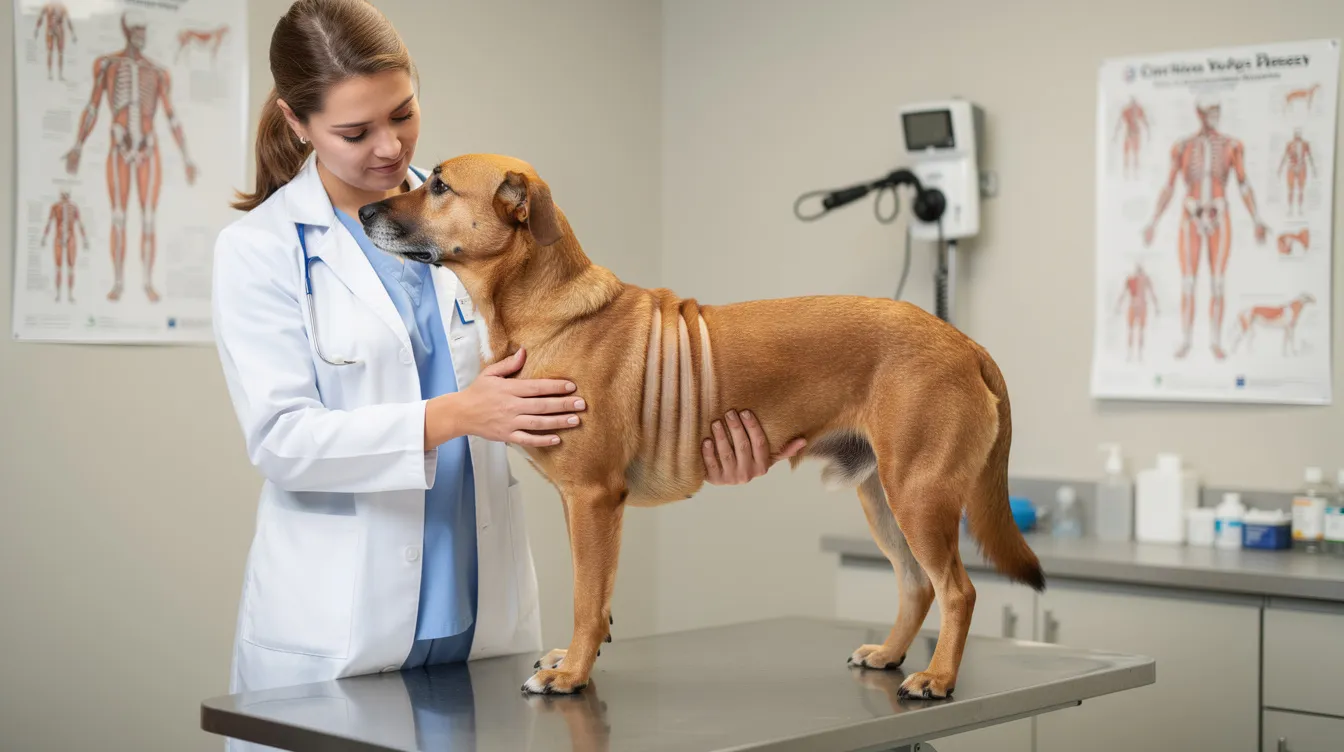
Daily calories are adjusted using BCS feedback:
-
If BCS rises above 5/9 or your pet’s weight is trending up, reduce daily calories by about 5–10% at a time.
-
If BCS falls below 4/9 or the dog is losing weight too quickly, increase calories modestly, always in consultation with a vet.
For dogs with a BCS of 7/9 or higher, a structured, vet-supervised weight control plan using calculated caloric restriction is essential to protect lean mass and organ function.
How do age and life stage change my dog’s daily calories?
Puppies, adult dogs, senior dogs, and pregnant or lactating dogs have very different caloric needs even at the same body weight.
Puppies: Growing dogs need more calories than adult dogs of the same size. Puppies under 4 months may need up to 3 × RER to support rapid growth, tapering to about 2 × RER from 4 months to maturity. Large- and giant-breed puppies require especially careful control of daily food to balance growth and prevent orthopedic issues.
Adult dogs: Healthy adult dogs at ideal body condition typically use a maintenance factor of about 1.4–1.8 × RER. Intact adults tend toward the higher end; neutered pets toward the lower end. These are the ranges most dog calorie calculators display.
Senior dogs: Many, but not all, older dogs have a lower activity level and slower metabolism, so senior dogs require fewer calories than younger dogs. However, seniors also carry a higher risk of hidden disease, so any unexplained weight change should trigger a veterinary check before adjusting the dog’s diet.
Pregnant and lactating dogs: Late gestation and especially peak lactation can push caloric needs to 2–4 times maintenance or more. These life stage demands require veterinary oversight and a complete, life-stage-appropriate diet – not simply more of the usual food.
How does activity level and lifestyle affect daily energy requirement?
Activity level is one of the biggest drivers of variation in daily energy requirement. The same dog may need different calories on a lazy week versus a hiking vacation.
|
Lifestyle |
Examples |
Approximate MER |
|---|---|---|
|
Sedentary |
Few short leash walks, mostly indoors |
1.2–1.4 × RER |
|
Moderate |
Daily play, regular walks |
1.4–1.6 × RER |
|
Very active / working |
Agility, herding, search-and-rescue |
2–5 × RER |
Highly active dogs may need twice as many calories as inactive dogs, and working dogs burn more energy than sedentary dogs due to their activity levels. Seasonal shifts – winter hikes versus hot, humid summers with shorter walks – also change daily energy expenditure. Owners should be prepared to adjust daily calories by small amounts (5–10%) and then monitor body condition.
Any dog starting a new intense exercise program should have a veterinary exam first, and calorie changes should be gradual to avoid digestive upset.
How can I use a dog calorie calculator or my vet’s guidance safely?
Calorie calculators estimate a dog’s daily energy requirements using inputs like species, dog’s current weight, ideal weight, body condition score, life stage, neuter status, and activity level. Calorie calculators consider factors like weight and activity level to produce a starting number.
Treat every calorie calculator result as a guideline, not a fixed prescription:
-
Start with the suggested daily calories.
-
Feed that amount consistently for 2–4 weeks.
-
Reassess your dog’s weight, body condition, and energy levels with your veterinarian.
Bring a detailed diet history to your vet visit – brand, flavor, dry foods versus canned, exact measuring tools used, treats, chews, and table scraps – so the vet can cross-check estimated dog calorie intake with the dog’s body condition and health status.
For dogs with obesity (BCS 7/9 or above), chronic disease, or on long-term medication, a calorie calculator should not replace a tailored veterinary weight management plan such as those used at the ROYAL CANIN Weight Management Clinic.
How do I turn daily calories into the right amount of food and treats?
Once you know your dog’s target daily calories, translate that number into portions. Check your dog’s food label for the calorie content – usually listed as kcal per cup or per can.
Example: If your dog needs 800 kcal/day and the kibble provides 400 kcal per cup, the dog should eat 2 cups per day, split across meals.
To measure food accurately, use a digital kitchen scale rather than volume scoops, since cups can vary and lead to unintentional overfeeding. Pre-portioning daily food into a container each morning prevents family members from double-feeding.
All calories count. Treats, dental chews, training rewards, and table scraps should together provide no more than about 10% of your dog’s total daily calories, with the remaining 90% coming from complete and balanced daily food. Healthier, lower-calorie treat ideas include:
-
Small pieces of carrot or green bean
-
A portion of the dog’s regular kibble set aside as training rewards
-
Commercial low-calorie treats in measured amounts
Always subtract treat calories from the daily total rather than feeding them on top of the calculated amount.

How can I tell if my dog is getting the right number of calories?
Calorie needs are dynamic. The best way to judge whether your dog’s caloric intake is correct is to watch trends over time, not rely on a single weigh-in.
A simple home monitoring plan:
-
Weigh your dog every 2–4 weeks on the same scale.
-
Check body condition using a BCS chart.
-
Note changes in appetite, stool quality, energy level, and coat condition.
Interpreting trends:
|
Observation |
Likely meaning |
Action |
|---|---|---|
|
Stable weight, ideal BCS, shiny coat |
Calories about right |
Maintain current feeding |
|
Gradual weight gain, rising BCS |
Dog is eating too many calories |
Reduce daily food by 5–10% |
|
Gradual weight loss, visible ribs, low energy |
Dog is getting fewer calories than needed, or illness |
Increase food or see vet |
Any sudden or unexplained weight change, increased thirst, vomiting, diarrhea, or marked behavior change should prompt an immediate veterinary visit rather than just adjusting calories at home. Overfeeding can cause obesity and related health problems, while underfeeding risks muscle depletion and poor health.
Safe weight loss should generally target about 1–2% of body weight per week for dogs, supervised by a veterinary health care team to preserve lean muscle and prevent rebound weight gain.
When should I talk to my veterinarian about my dog’s calorie needs?
While owners can estimate and monitor daily calories themselves, veterinary input is crucial whenever there is uncertainty, existing disease, or a weight problem. Consult your veterinarian if:
-
Your dog is overweight or obese (BCS 6/9 or higher).
-
Your dog’s weight is changing without explanation.
-
Your dog has chronic medical conditions such as arthritis, diabetes, heart disease, or kidney disease.
-
You are considering a home-prepared diet or a major change in eating habits.
-
You plan to start a significant new exercise routine.
A nutrition-focused veterinary visit should include a full physical exam, body condition score assessment, weight history, and possibly lab work to rule out metabolic diseases. A veterinary nutritionist can help fine-tune a plan for dogs with complex health conditions.
Specialized services such as the ROYAL CANIN Weight Management Clinic at the University of Liverpool use detailed diet histories, evidence-based calorie calculations, and regular follow-up to adjust each dog’s caloric plan over time. View calorie planning as an ongoing collaboration with your veterinary team – for both dogs and cats – not a one-time calculation.

Frequently Asked Questions
How many times a day should I feed my dog if I know their daily calories?
Most healthy adult dogs do well with their daily calories divided into two meals - morning and evening. Some small-breed or very active dogs may benefit from three smaller meals to maintain steady energy and reduce begging. Choose a routine that fits your dog's health and lifestyle, and keep meal timing consistent day to day.
Is free-feeding dry food a good idea if my dog maintains weight?
Leaving food down all day can work for a few self-regulating dogs but makes it very hard to track actual daily calories. It often leads to gradual weight gain, especially in neutered pets or low-activity dogs. Measured meals allow accurate calorie control, easier use of a dog calorie calculator, and better monitoring of appetite changes that might signal illness.
What should I do if my dog stops losing weight on a diet plan?
A plateau is common during weight loss. It often happens because a dog's lower body weight reduces its daily energy requirement, or because hidden calories from treats, chews, or table scraps have crept back in. Keep a detailed food diary for 1–2 weeks, re-weigh food portions, and consult your veterinarian to decide whether to slightly reduce daily calories further or adjust exercise - while ensuring weight loss remains around 1–2% per week.
How do I handle calories if I feed a homemade or raw diet?
Homemade and raw diets can vary widely in calorie density depending on ingredients, fat content, and preparation. Owners need to use reliable food composition data, weigh all ingredients, and calculate total daily calories carefully. Home-prepared diets should be formulated with the help of a veterinary nutritionist to ensure they are complete and balanced, and any calorie targets should still be based on RER and body condition, just as with commercial diets.
Does my dog need fewer calories after being spayed or neutered?
Many dogs experience a reduction in daily energy requirement after spay or neuter surgery, partly due to hormonal changes affecting metabolism and activity level. Continuing to feed the same calories may lead to slow weight gain over time. Discuss a modest calorie reduction and close body condition monitoring with your veterinarian in the months after surgery, adjusting if the dog's body condition score begins to creep above the ideal 4–5/9.
References
- World Small Animal Veterinary Association (WSAVA) Global Nutrition Committee. WSAVA Global Nutrition Guidelines. Journal of Small Animal Practice . 2011;52(7):385–396.
- Association for Pet Obesity Prevention. "2018 Pet Obesity Survey Results." Published 2019. Accessed via Association for Pet Obesity Prevention resources.
- American Animal Hospital Association (AAHA). 2021 AAHA Nutrition and Weight Management Guidelines for Dogs and Cats. Journal of the American Animal Hospital Association . 2021;57(3):153–174.
- Laflamme DP. Development and validation of a body condition score system for dogs. Canine Practice . 1997;22(4):10–15.
- German AJ. Weight management in obese pets: the tailoring concept and how it can improve results. Acta Veterinaria Scandinavica . 2016;58(Suppl 1):57.
- German AJ, Holden SL, Bissot T, et al. A high protein high fiber diet improves weight loss in obese dogs. Journal of Veterinary Internal Medicine . 2010;24(2):282–291.
- National Research Council (NRC). Nutrient Requirements of Dogs and Cats . National Academies Press; 2006.

Georgia Woods
RVN — ROYAL CANIN® Weight Management Clinic Nurse
Georgia Woods trained as a Veterinary Nurse in 2001 and qualified in 2004, going on to run nurse-led obesity clinics and work in emergency and critical care. She completed the ROYAL CANIN® Pet Health Councillor course, and since 2015 has been the ROYAL CANIN® Weight Management Clinic Nurse at the University of Liverpool Small Animal Teaching Hospital, where she works exclusively with obese pets.
This article is for general information only and is not a substitute for professional veterinary advice. Always consult your veterinary surgeon about the health of your pet.